Imagine the sun rising over a cobblestone piazza in Florence. You step into a local bar. The air smells of roasted beans. Cups clink softly against marble.
You confidently order a “latte.”
The barista smiles and slides a tall glass of cold milk across the counter. No espresso. No foam. Just milk.
This is not a joke. It is a classic linguistic trap. In Italy, language and lifestyle are inseparable from coffee. Therefore, to understand authentic Italian latte traditions, you must look beyond the milk and into history, timing, and social rules.
The Linguistic Evolution of the Latte
Many visitors are surprised to learn that “caffè latte” was popularized by an American writer. In fact, William Dean Howells recorded the term in the 19th century. He was a diplomat—not a Roman barista.
As the drink traveled to the United States, marketers simplified the name. “Caffè latte” became just “latte.” This worked perfectly in Seattle. However, it created confusion in Italy.
In Italian, latte simply means milk.
For this reason, ordering “latte” alone will likely result in a glass of dairy. If you want the real thing, you must ask for caffè latte.

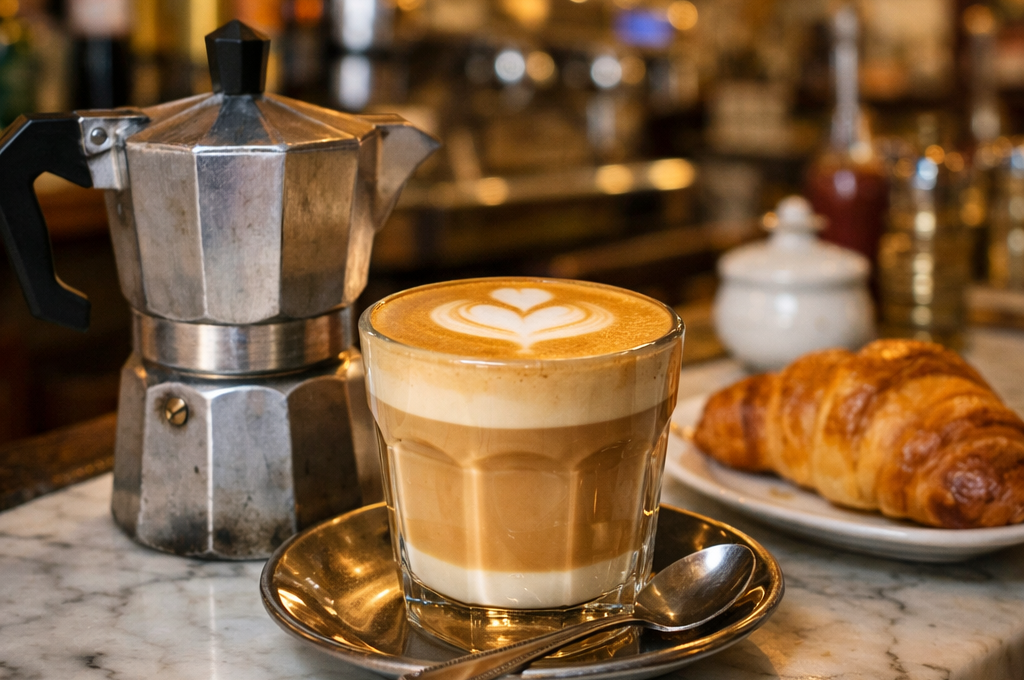
This image was generated using artificial intelligence (AI) for illustrative purposes only.
The Sacred 11:00 AM Rule
Many Western coffee drinkers enjoy milk-based drinks all day. In contrast, Italians follow strict timing rules.
Most locals avoid ordering milk-based coffee after 11:00 AM.
Why? Because milk is considered heavy. Italians believe dairy after lunch can disrupt digestion. As a result, the caffè latte remains a breakfast-only ritual.
By midday, the palate shifts. Espresso becomes the drink of choice—sharp, quick, and efficient. This boundary reflects how Italian latte traditions prioritize biological comfort over indulgence.
The Moka Pot: Where the Ritual Begins
Long before espresso machines dominated café counters, the rhythm of Italian mornings began with a small aluminum pot resting over a flame.
Invented in 1933 by Alfonso Bialetti, the Moka pot quickly became a household essential. It was not a luxury item. It was practical, affordable, and deeply democratic. More importantly, it transformed kitchens into miniature coffee bars.
In many Italian homes, the day still starts with the gentle hiss of steam rising through the chamber. Water heats below. Pressure builds naturally. Then, with a soft gurgle, dark coffee flows upward into the upper compartment. The sound itself is part of the ritual.
Unlike commercial espresso machines, the Moka pot produces a brew that is rich yet less aggressive. It carries body without excessive sharpness. For this reason, it pairs beautifully with warm milk.
Rather than frothing milk with steam wands, families simply heat milk in a small saucepan. The coffee is poured first. The milk follows. No performance. No ornament. Just balance.
This domestic preparation reflects the core of authentic Italian latte traditions. Coffee is not always about spectacle or machinery. Instead, it is about consistency, familiarity, and the quiet comfort of repetition.
Even today, while cafés thrive in every city, the Moka pot remains the true soul of the Italian kitchen.
Microfoam and Ingredient Purity
Texture separates the latte from the cappuccino.
Italian caffè latte uses steamed milk—not thick foam. The texture should feel silky and fluid. In other words, it should resemble liquid velvet rather than stiff froth.
Moreover, traditional Italian lattes avoid syrups like vanilla or caramel. Italians believe quality ingredients speak for themselves.
Steaming milk naturally enhances sweetness by breaking down lactose into simple sugars. Therefore, adding syrup suggests poor-quality coffee. Italian coffee culture values purity over decoration.
Seattle Art vs. Italian Utility
Today, many coffee shops focus on latte art. Hearts and rosettes dominate social media feeds.
However, this aesthetic emerged in Seattle during the late 1980s. In Italy, speed and utility matter more than visuals.
Regulars often stand at the bar. They drink quickly and move on. Consequently, baristas prioritize efficiency over elaborate designs.
This contrast reveals a deeper philosophical divide: spectacle versus simplicity.
Why Italian Latte Traditions Still Matter
The story of the latte reflects broader cultural values.
Italians respect timing. They value digestion. They refuse to mask the character of coffee with excess sweetness.
In a world obsessed with customization and excess, the Italian latte remains quietly uncompromising. They remind us that coffee is not just a beverage—it is a ritual shaped by history, biology, and social codes.
Recreating this morning ritual requires more than espresso; it begins with understanding the tools Italians have trusted for generations — as outlined in our guide to traditional coffee equipment.
For a deeper exploration of modern coffee culture and specialty trends, read our complete guide to contemporary coffee movements.
FAQ – Authentic Italian Latte Traditions
1. What is the difference between latte and caffè latte in Italy?
In Italy, “latte” simply means milk. If you order a latte, you will likely receive a glass of milk. A caffè latte refers to coffee mixed with warm milk, typically consumed at breakfast.
2. Why don’t Italians drink latte after 11 AM?
Italian coffee culture follows traditional digestion beliefs. Milk is considered heavy and better suited for the morning. After 11 AM, most Italians switch to espresso to avoid discomfort after lunch.
3. Is latte art traditional in Italy?
No. Latte art became popular in the United States during the late 20th century. Traditional Italian latte preparation focuses on taste and texture rather than decorative foam designs.
4. Do Italians make lattes at home?
Yes. Many Italian families prepare coffee using a Moka pot and combine it with warmed milk. This home method reflects authentic Italian latte traditions rooted in simplicity.
5. What milk texture is used in an authentic Italian latte?
Authentic Italian lattes use lightly steamed milk with minimal foam. The texture should be smooth and silky, not thick or heavily frothed like a cappuccino.
6. Is it rude to order a latte in Italy?
It is not rude, but it may cause confusion. To avoid misunderstandings, it is better to order “caffè latte” when visiting Italy.
7. What are authentic Italian latte traditions?
Authentic Italian latte traditions emphasize timing, simplicity, and ingredient quality. The drink is typically enjoyed at breakfast, prepared with steamed milk, and rarely customized with syrups or toppings.