

Apple Tests Advanced Foldable Display Technology for iPhone Fold: Engineering Ambition Meets Market Disruption
Apple is reportedly entering the foldable smartphone race with a level of caution and technical rigor that reflects its long-standing product philosophy: arrive late, but redefine the category. According to supply-chain reports from The Elec, later corroborated by MacRumors, Apple is currently testing next-generation protective display layers for what is widely referred to as the iPhone Fold — the company’s first foldable iPhone.
Unlike many competitors that rushed early foldable models to market, Apple appears focused on solving one of the category’s most persistent weaknesses: long-term display durability.
PET vs CPI: Apple’s Critical Display Decision
At the heart of Apple’s testing process is the evaluation of two protective film materials that sit above ultra-thin glass (UTG):
Polyethylene Terephthalate (PET) – A widely used polymer film currently found in devices such as Samsung’s Galaxy Z Fold and Z Flip series.
Clear Polyimide (CPI) – A higher-cost, more advanced material offering greater surface hardness, improved scratch resistance, and superior flexibility under repeated stress.
While PET has proven cost-effective and reliable, CPI is increasingly viewed as a premium alternative. According to MacRumors, Apple is seriously considering CPI as a way to differentiate its foldable display from existing solutions on the market.
This decision is not trivial. In foldable smartphones, the polymer film is the actual touch surface users interact with daily. It must withstand tens of thousands of folding cycles, resist micro-abrasions, and maintain touch sensitivity — all without compromising visual clarity.
Apple’s reported interest in CPI suggests a willingness to absorb higher component costs in exchange for long-term durability and a more “glass-like” user experience, an area where many foldables still fall short.
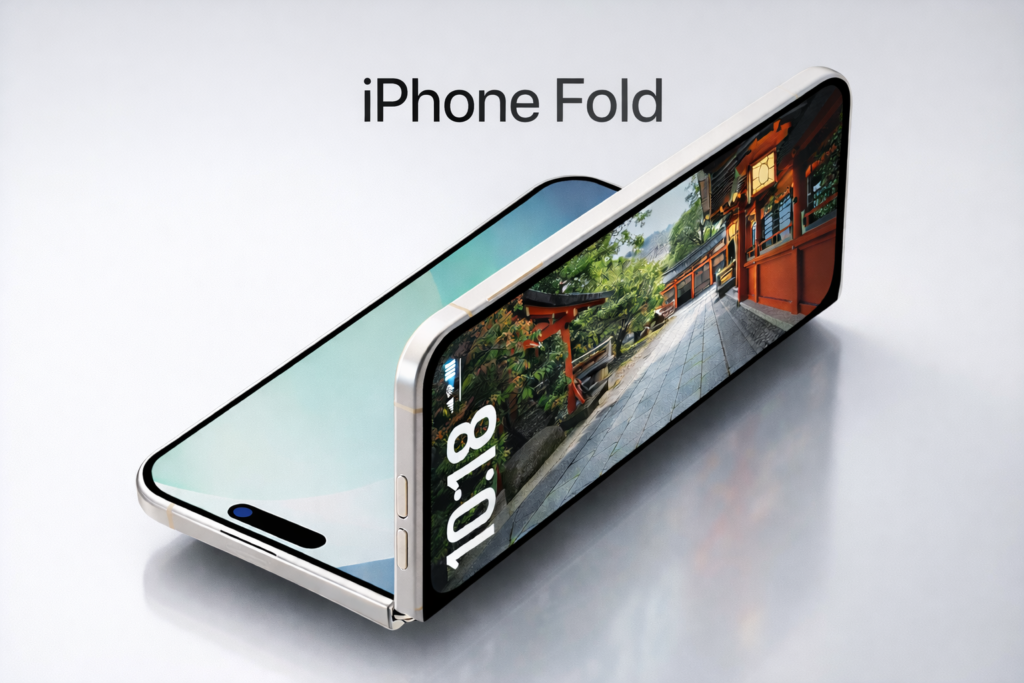
This image is an AI-generated illustration created for conceptual and illustrative purposes only
Ultra-Thin Glass and Supply Chain Readiness
The foldable display stack under development reportedly consists of ultra-thin glass laminated with a polymer film, a structure now common across the industry but difficult to perfect.
Two key suppliers have emerged in reports:
Kolon Industry, a South Korean materials company, is cited as a leading candidate to supply CPI films, having already invested in mass-production capacity for foldable devices.
Lens Technology, based in China, is expected to provide the ultra-thin glass and manage the bonding process between glass and polymer layers.
The early engagement of well-known suppliers implies that Apple’s foldable display project has progressed past the conceptual stage and into real-world validation, despite the company reportedly keeping its final material decision open.
Rumored Display and Hardware Specifications
While Apple has not publicly acknowledged the existence of an iPhone Fold, multiple industry sources and analysts have converged on similar hardware expectations:
Primary foldable display: approximately 7.8 inches, reportedly engineered to minimize or visually eliminate the crease — a major pain point in current foldables.
Cover display: roughly 5.5 inches, allowing full smartphone functionality when closed.
Form factor: a book-style inward fold, similar to the Galaxy Z Fold rather than clamshell designs like the Z Flip.
Additional rumors point to the inclusion of an A20-series chipset, Apple’s in-house C2 5G modem, and biometric authentication via Touch ID integrated into the side button, likely due to space constraints within the folding chassis.
Industry analysts, including Ming-Chi Kuo, have suggested a potential launch window in late 2026, aligning with Apple’s typical product cadence once a technology meets internal reliability thresholds.
Why Foldables Are Technically Hard — and Why Apple Is Taking Its Time
Foldable smartphones present a unique engineering challenge. Unlike slab phones, they require:
Flexible displays that resist permanent deformation
Hinges capable of withstanding years of mechanical stress
Materials that remain optically clear while bending thousands of times
Early foldables often suffered from visible creases, fragile screen layers, and inconsistent durability. Apple’s reported emphasis on CPI suggests a deliberate attempt to address these shortcomings before entering the market.
From an engineering perspective, Apple’s restraint aligns with its historical approach. The company waited years before entering markets like tablets, smartwatches, and large-screen phones — but when it did, it often reset consumer expectations.
Market Impact: Can iPhone Fold Disrupt an Established Segment?
From a NexoMagz editorial standpoint, the arrival of an iPhone Fold would be less about novelty and more about legitimization.
- Apple’s Ecosystem Advantage
Apple would not be launching a standalone foldable, but a foldable deeply integrated into the iOS ecosystem — from iCloud and AirDrop to Continuity with Mac and iPad. This alone could drive adoption among existing Apple users who have avoided foldables due to reliability concerns.
- Premium Positioning
Expected pricing north of USD 1,999 would place iPhone Fold squarely in the ultra-premium tier. Apple is unlikely to compete on volume; instead, it would target users seeking durability, polish, and long-term software support.
- Pressure on Competitors
If Apple successfully delivers a foldable display with superior durability and minimal creasing, competitors such as Samsung, Huawei, and Google would face renewed pressure to advance materials science rather than incremental design tweaks.
Conclusion: A Calculated Entry, Not a Gamble
Apple’s reported testing of advanced foldable display materials underscores a broader strategy: engineering maturity over market speed. By prioritizing display durability — the single most criticized aspect of foldable phones — Apple appears intent on redefining expectations rather than chasing trends.
While many details remain unconfirmed, the consistency of reports from credible supply-chain and industry sources suggests that iPhone Fold is not a question of if, but when. And if Apple succeeds, its first foldable device could reshape the competitive landscape of foldable smartphones — not by being first, but by being refined.
Apple’s approach mirrors its historical strategy in emerging product categories, where the company favors refinement and ecosystem readiness over rushing to market — a pattern that has defined many of its past hardware launches.