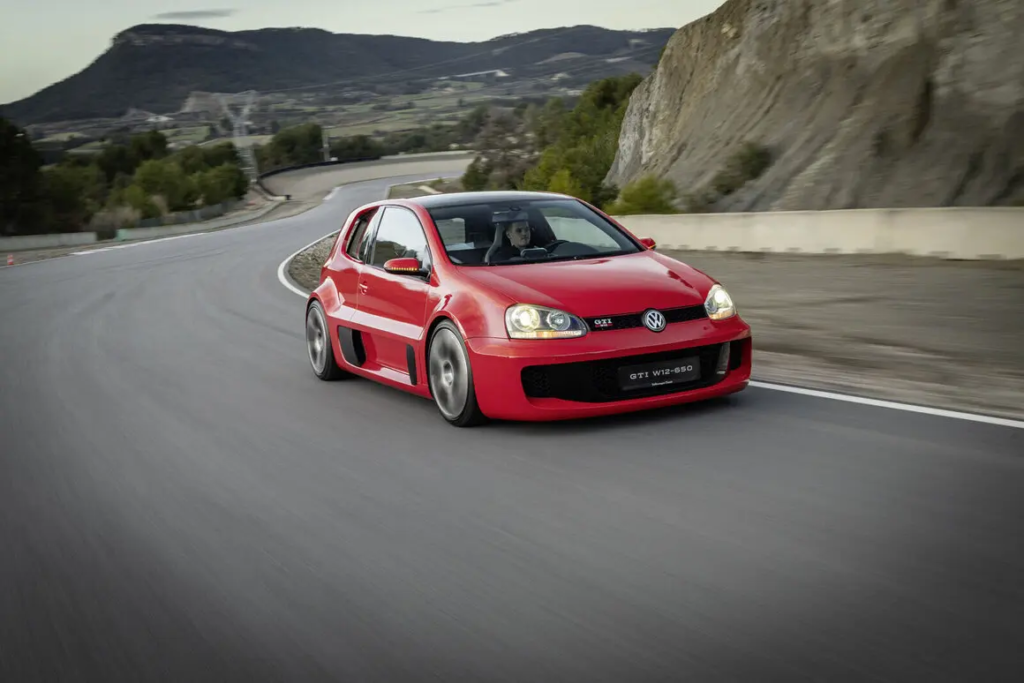
The Golf GTI W12-650 remains the most unhinged engineering experiment in the history of the German “people’s car” brand. To celebrate the 50th anniversary of the GTI nameplate, Volkswagen recently pulled this mid-engined monster out of its secret storage, draped it in a provocative red coat, and reminded the world that they once possessed a sense of humor. While the latest Mk8 generation focuses on digital cockpits and surgical efficiency, the W12-650 represents a period of absolute mechanical madness.
The Engineering Insanity of the Golf GTI W12-650
Volkswagen engineers didn’t just tune a four-cylinder engine for this 2007 project; they fundamentally rewrote the architecture of the hatchback. They stripped a three-door Golf shell and shoved a 6.0-liter, twin-turbocharged W12 engine directly behind the driver’s seat. This titan of an engine came straight from the Car and Driver approved archives of the Phaeton luxury sedan and the Bentley Continental GT.
The resulting power figures still sound fictional today. The Golf GTI W12-650 produces a massive 641bhp and 553lb ft of torque. Unlike the standard front-wheel-drive GTI, this beast channels all that fury to the rear wheels through a six-speed Tiptronic gearbox. Volkswagen claimed a 0-62mph time of just 3.7 seconds. Even more shocking, the car features a theoretical top speed of 201.8mph, placing it in the same aerodynamic territory as dedicated supercars from the mid-2000s.
Design Secrets: Form Following Fire
Creating a stable platform for a 200mph Golf required more than just a big engine. The Golf GTI W12-650 sits significantly lower and wider than any production GTI. To manage the immense heat generated by the 12-cylinder furnace behind the driver, designers integrated massive cooling scoops into the rear C-pillars. These aren’t just cosmetic flourishes; they provide the vital airflow necessary to keep the twin-turbocharged W12 from melting the rear of the car.
The roof features a massive carbon fiber panel that doubles as a functional air intake. This design choice allowed Volkswagen to maintain a sleek profile without mounting a giant, unsightly rear wing. Instead, they utilized underfloor aerodynamics and a massive rear diffuser to keep the car pinned to the tarmac. The 19-inch wheels, which looked gargantuan in 2007, now serve as a reminder of how quickly automotive proportions evolved. Inside, the cabin trades family-friendly plastics for Alcantara, race-inspired toggle switches, and a fire extinguisher where the glovebox used to be.
Why the W12-650 Still Matters Today
In an era of electrification and downsizing, the Golf GTI W12-650 stands as a monument to “over-engineering.” It represents the peak of the Ferdinand Piëch era, where Volkswagen spent billions to prove they could out-engineer anyone on the planet. This car wasn’t just a show pony; it was a fully functional prototype that Top Gear’s own Jeremy Clarkson famously wrestled around the track. As documented by Top Gear, the car proved notoriously difficult to handle at the limit due to its short wheelbase and immense torque, but its existence alone boosted the GTI’s street cred for a generation.
The decision to bring the car back in red for the GTI’s 50th birthday signals Volkswagen’s desire to reconnect with its enthusiast base. While the industry moves toward synthetic engine sounds and motor-driven torque, the raw, mechanical symphony of a 6.0-liter W12 reminds us why we fell in love with the GTI brand in the first place. It remains a “bespoke design study” that never saw production, yet it influenced the aggressive styling of the subsequent GTI generations.
Technical Specifications and Market Context
When compared to modern rivals, the Golf GTI W12-650 still holds its own. According to data from Motor Trend, few modern hatchbacks can match its raw cylinder count or mid-engined layout. The car serves as a bridge between the humble hatchback and the exotic supercar, a niche that brands like Renault previously explored with the 5 Turbo and Clio V6.
- Engine: 6.0L Twin-Turbo W12
- Output: 641bhp / 553lb ft
- Layout: Mid-engine, Rear-wheel drive
- Transmission: 6-Speed Tiptronic
- Top Speed: 201.8 mph
- Construction: Steel shell with Carbon Fiber roof and aero components
Volkswagen continues to use the GTI festival at Wörthersee (and its successors) to showcase these “mad” concepts. By revisiting the W12-650, the brand acknowledges that while the future is electric, the soul of the GTI is built on audacious performance and shocking design choices. Critics at Autocar often cite this car as the ultimate “what if” moment in automotive history. If Volkswagen had ever greenlit a limited production run, it likely would have become the most collectible hatchback in existence. For now, we must settle for seeing it in its new red livery, a vibrant reminder of a time when the Golf GTI went truly, gloriously unhinged.