Uncovering the Honda NSX Secrets requires looking back at the 1990s, an era when Japanese engineering decided to humiliate the European establishment. Before the NSX, supercars were temperamental, physically exhausting, and frequently unreliable, but Honda changed the trajectory of performance motoring forever by introducing a car that worked as well as a Civic while outperforming a Ferrari.
Honda NSX Secrets: The Aluminium Frame Revolution
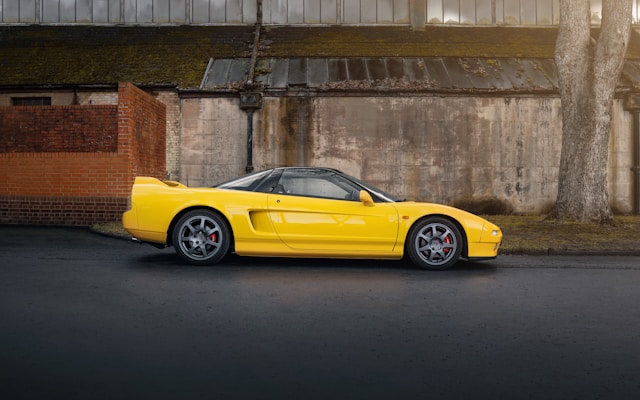
The Honda NSX Secrets begin with its construction, a feat of engineering that left the industry scrambling to catch up. When Honda launched the NSX in 1990, it became the first production car to feature an all-aluminium semi-monocoque, utilizing a revolutionary extruded aluminium frame and body. This choice kept the weight at a lean 1,370kg, providing a power-to-weight ratio that threatened much more expensive machinery.
While the European brands relied on traditional steel frames, Honda’s metallurgy experts worked tirelessly to ensure the chassis remained stiff enough for world-class handling without the weight penalty. This obsession with light-weighting is why many Autocar reviewers still consider the first-generation NSX a benchmark for purity. The car didn’t just use aluminium for the skin; the suspension components were also forged aluminium, reducing unsprung weight and allowing the dampers to react with a precision previously unknown in road cars.
The Ferrari 348 Reality Check
Perhaps the most satisfying of the Honda NSX Secrets is the direct impact it had on Maranello. At the time of the NSX’s development, Ferrari was producing the 348—a car often described as lazy, complacent, and dynamically flawed. When the NSX began running rings around the 348 in independent testing, Ferrari’s leadership faced a crisis. The Japanese newcomer proved that a mid-engine supercar didn’t need a heavy clutch or a temperamental gearbox to be “soulful.”
Honda focused on ergonomics and visibility, drawing inspiration from the 360-degree visibility of an F-16 fighter jet cockpit. By making the car easy to see out of and comfortable to sit in, they exposed the ergonomic nightmares of the Italians. This forced a massive culture shift at Ferrari, eventually leading to the much-improved F355. Without the NSX, the modern, usable supercar might never have existed.

Ayrton Senna’s Invisible Hand
No discussion of Honda NSX Secrets is complete without mentioning Ayrton Senna. While many brands use racing drivers for marketing fluff, Senna’s involvement was critical. During testing at Suzuka, Senna famously told the engineers that the car felt “a bit fragile.” This feedback led Honda to increase the chassis stiffness by 50% just before production.
Senna’s influence ensured that the NSX wasn’t just a reliable commuter in a fancy suit; it was a sharpened weapon. The mechanical texture of the six-speed gearbox and the communicative nature of the steering are direct results of this high-level development. For those looking to dive deeper into JDM Performance History, the Senna connection remains the gold standard of driver-engineer collaboration.
The McLaren F1 Blueprint
One of the most profound Honda NSX Secrets involves Gordon Murray, the designer of the McLaren F1. Murray owned an NSX for seven years and famously used it as the dynamic benchmark for the greatest supercar of all time. He was so impressed by the NSX’s ride quality and gearbox that he initially asked Honda to build the engine for the F1.
Although Honda declined the engine request, the NSX’s DNA lived on in the McLaren. Murray wanted the F1 to have the same “everyday usability” and impeccable air conditioning that the Honda offered. According to Car and Driver, the NSX was the only car Murray felt could truly be used as a template for the F1’s refinement. It is rare for a Japanese sports car to dictate the terms of a British hypercar’s development, but the NSX was no ordinary car.
VTEC Performance and Engineering Purity
Under the glass hatch sits a 3.0-litre (and later 3.2-litre) V6 featuring Honda’s legendary VTEC system. While 290bhp sounds modest by today’s standards, the way the engine delivers that power is intoxicating. It whirrs into life with a mechanical hum, but as the needle sweeps past 6,000rpm, the cam profile shifts, and the engine barks with a hard-edged intensity.
The NSX never chased the trend of rowdiness or artificial exhaust pops. Instead, it offered a fluent ride and a sensational balance that rivals the best from Lotus or Alpine. Even as it aged, Honda kept refining the formula. By the time it went off sale in 2005, it still featured a cassette player—a charmingly dated relic in a car that otherwise felt decades ahead of its time. As noted by Top Gear, the original NSX remains an all-time great precisely because it didn’t try to shout; it simply performed.
When Honda attempted to revive the nameplate in 2017 with a complex hybrid system, the magic proved difficult to recapture. The original NSX succeeded because it was a revolution of simplicity and engineering integrity. It took the arrogance of the European supercar world and replaced it with Japanese precision, proving that a hero is even better when you can actually drive it every day.
Discover the latest car news, reviews, and automotive trends by exploring our coverage here.