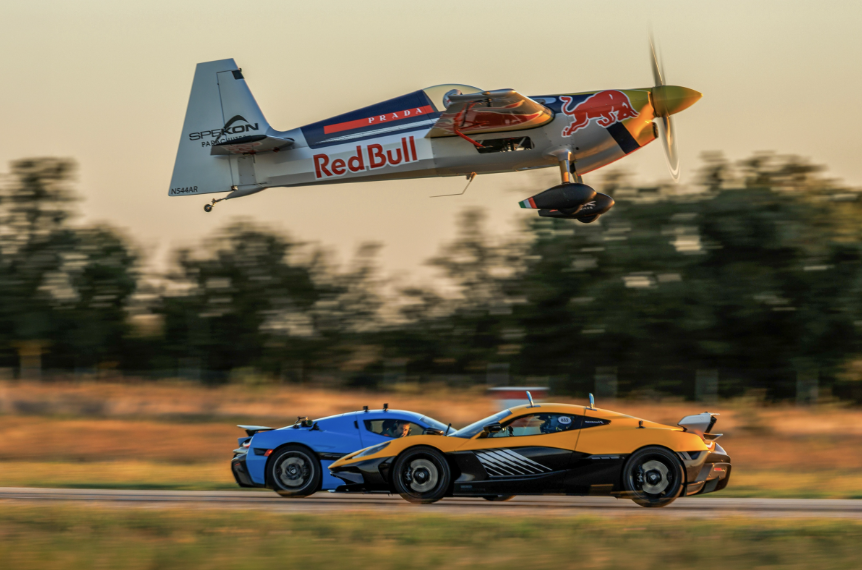
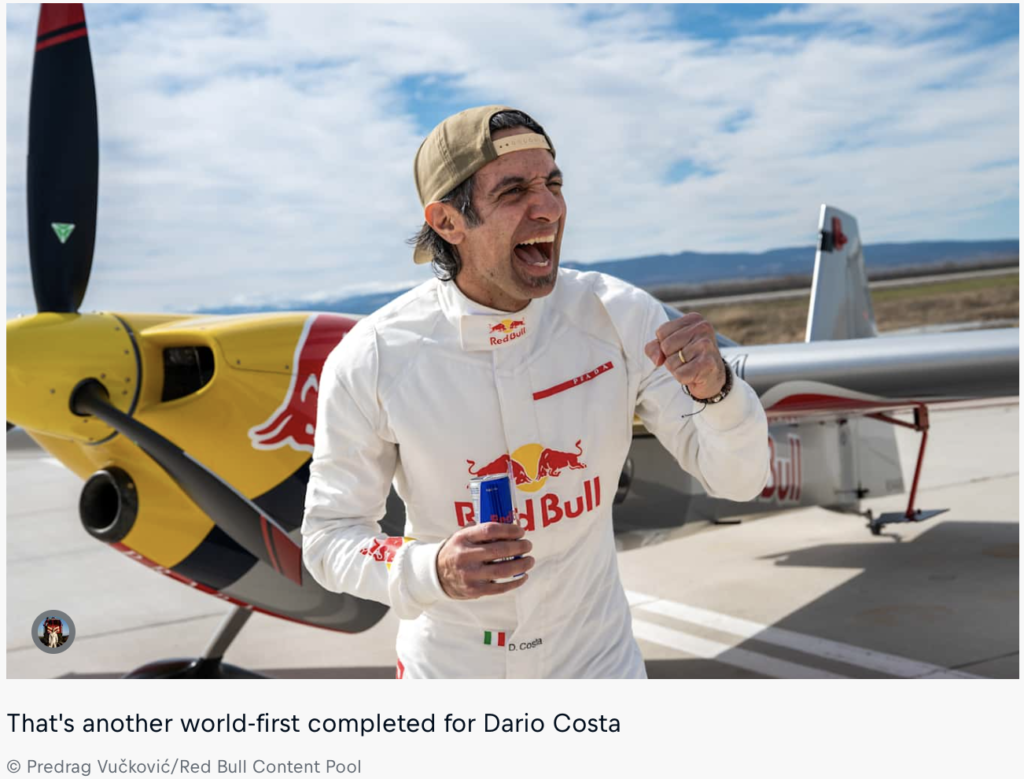
The Rimac Nevera R just proved that 2,078bhp serves more purposes than simply melting tires on a drag strip. While most owners treat their multi-million pound electric hypercars like museum pieces, Red Bull decided to use one as a glorified training wheels system for a fixed-wing aircraft. In a feat of engineering madness, pilot Dario Costa recently became the first human to land a plane on a moving train. He didn’t achieve this through luck; he spent three days at Pula Airport in Croatia chasing the world’s most powerful production EV in reverse.
This isn’t just another marketing exercise for an energy drink brand. It represents a bizarre intersection of aerospace precision and automotive overkill. Rimac positioned the Rimac Nevera R as a “high-precision moving reference platform.” Essentially, Costa needed a target that could maintain surgical speed consistency while providing a visual anchor for a landing that he effectively performed blind.
Why Red Bull Chose the Rimac Nevera R for Training
When you are trying to land a Zivko Edge 540 on a cargo train at 54mph, you don’t typically reach for a car capable of hitting 256mph. However, the TopGear.com team notes that the “R” variant offers the mechanical grip and software calibration required for micro-adjustments that a standard vehicle simply cannot match.
The landing speed of 54mph sits dangerously close to the stall speed for Costa’s aircraft. In normal conditions, this plane touches down at roughly 92mph. By forcing the aircraft into this low-speed window, Costa faced immense physical and cognitive demands. The Rimac Nevera R acted as a literal safety net, allowing him to synchronize his speed and alignment against a platform that wouldn’t twitch or hesitate.
Reversing at 54mph to Simulate Turbulence
The most absurd detail of this training regimen involves the orientation of the car. Rimac engineers didn’t just drive the car down the runway; they drove it backwards. The logic sounds like something from a fever dream, but the physics are sound. By driving the Rimac Nevera R in reverse at 54mph, the car’s aerodynamic profile generated severe wake turbulence.
This simulated the “dirty air” that the moving cargo train would produce on the day of the actual stunt. A blocky SUV might have produced similar air disturbance, but it lacked the low-slung precision and rapid throttle response needed to stay perfectly under the plane’s nose. According to Car and Driver, the Nevera R’s revised aero package and stiffened chassis make it an ideal, albeit expensive, tool for such high-stakes calibration.
A Question of Hypercar Utility
We have to ask: why use a £2.3m hypercar for a job that a Dacia Spring could technically achieve in terms of raw speed? The answer lies in the torque delivery of Electric Hypercars. When Costa’s plane hovered inches above the Rimac, the car had to maintain a velocity that didn’t vary by even a fraction of a mile per hour. Internal combustion engines, with their gear changes and power bands, struggle with that level of granular consistency at low speeds.
The Rimac Nevera R utilizes quad-motor torque vectoring that can adjust power delivery thousands of times per second. This allowed the driver to hold a perfectly steady pace regardless of the wind resistance pushing against the car or the aerodynamic downwash from the plane above.
The Performance Specs of the Training Tool
To understand the scale of this “training tool,” one must look at the specifications that Dario Costa had at his disposal:
* Power Output: 2,078bhp (1,550kW)
* 0-60mph: 1.74 seconds
* Orientation for Stunt: Reverse
* Training Speed: 54mph (87km/h)
While the Rimac Nevera R spent most of its time at a fraction of its potential, the headroom provided by its powertrain ensured that the pilot had a rock-steady reference point. As noted by Autocar.co.uk, the R variant is significantly more track-focused than the standard Nevera, featuring a fixed rear wing and a more aggressive stance that likely helped stabilize the air for Costa’s rehearsal.
Engineering Overkill or Necessary Precision?
Critics might argue that Red Bull’s choice of vehicle was purely for the cameras. Yet, when a human life is balanced on the wing of a plane and the roof of a train, “overkill” becomes a secondary concern to “reliability.” The Rimac Nevera R provided a stable, repeatable environment in an inherently unstable scenario.
The successful touch-and-go landing on the moving train proves that the three days of airport rehearsals paid off. Costa’s ability to align his landing gear with a narrow cargo container required the reaction timing that only a world-class athlete—and a world-class car—could facilitate.
The motoring world often views these hypercars as toys for the ultra-wealthy. However, seeing the Rimac Nevera R used as a high-tech instrument for aerospace development shifts the narrative. It isn’t just a car; it is a mobile laboratory capable of simulating complex physics on demand. Whether reversing at 54mph or charging toward 250mph, the Nevera R continues to redefine what we expect from the electric era.