
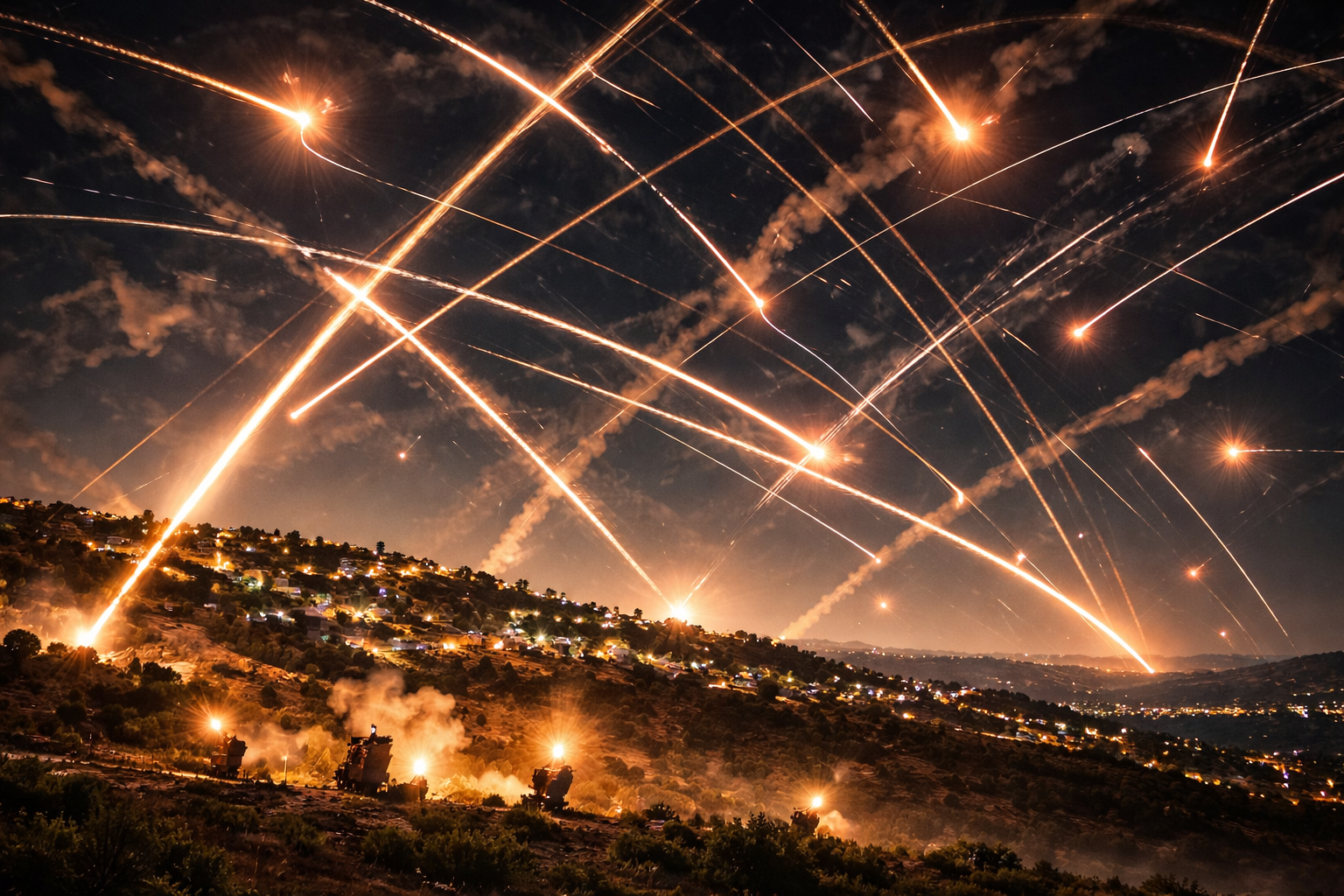
The geopolitical landscape of the Middle East shifted violently on Wednesday as the border between Israel and Lebanon became the flashpoint for a significant military escalation. In a coordinated saturation attack, the militant group Hezbollah launched a barrage of 100 rockets toward northern Israel, exposing rare vulnerabilities in the nation’s multi-layered defense architecture. Reports from the region indicate that the Iron Dome, a system often touted as the gold standard of short-range missile defense, was significantly overwhelmed by the sheer volume of incoming fire, successfully intercepting only approximately half of the projectiles.
The Strategic Failure of the Iron Dome in Northern Israel
For over a decade, the Iron Dome has provided a psychological and physical safety net for Israeli civilians, boasting a historical success rate of nearly 90 percent. However, the recent Hezbollah barrage has raised urgent questions regarding the system’s “saturation point.” According to sources within the Israel Defense Forces (IDF), the density of the 100-rocket salvo was specifically designed to exhaust the system’s Battle Management and Control (BMC) units. When a high volume of projectiles enters a narrow corridor simultaneously, the system must prioritize targets based on predicted impact zones, sometimes allowing lower-priority rockets to slip through to avoid depleting interceptor stockpiles.
This incident is not an isolated technical glitch but rather a reflection of evolving asymmetric warfare tactics. As reported by Reuters, militant groups have spent years studying the limitations of Israeli defense technology, seeking ways to bypass the Tamir interceptor missiles that serve as the system’s primary kinetic tool. The failure to stop 50% of the incoming fire has caused alarm in Tel Aviv, as it signals that the technological edge Israel once maintained may be narrowing in the face of persistent, high-volume rocket fire.
Operation Epic Fury and the Looming Ground Invasion
In the wake of the breach, the Israeli government and military leadership have signaled a pivot from defensive posturing to offensive maneuvers. The IDF is reportedly finalizing preparations for a ground invasion into southern Lebanon to neutralize Hezbollah launch sites and infrastructure. This escalation is part of a broader, joint military framework known as “Operation Epic Fury,” a mission involving close coordination between Israeli forces and U.S. military assets in the region.
The involvement of the United States in this capacity suggests a wider strategic objective. While the primary goal is to halt the rocket fire, the operation also aims to deter other Iranian proxies, including the Houthi rebels in Yemen, who have expressed support for Hezbollah’s actions. AP News reports that the IDF has already begun conducting precision airstrikes against projectile launchers and Hezbollah command centers across Lebanon as a precursor to the ground phase.
How the Iron Dome Operates Under Pressure
To understand why the system struggled, one must look at the mechanics of its interception cycle. The Iron Dome relies on a three-part process:
1. Radar Detection: High-resolution radar tracks the incoming projectile from the moment of launch.
2. Battle Management: The BMC unit calculates the trajectory and determines if the rocket is heading for a populated area.
3. Interception: If the threat is validated, a Tamir missile is launched to destroy the rocket in mid-air.
While highly effective against low-speed, short-range rockets—such as those historically fired from the Gaza Strip—the system faces significant hurdles when dealing with the more sophisticated arsenals held by Hezbollah. The Lebanese group possesses rockets with varied flight paths and higher velocities, which can complicate the BMC’s calculation window.
Regional Escalation: From Hezbollah to Houthi Threats
The current conflict is quickly transcending the Israel-Lebanon border. Israeli citizens have been advised by the Home Front Command to remain near shelters as the threat of a multi-front war looms. There is growing concern that the Houthi movement in Yemen may utilize the current distraction to launch long-range drones or ballistic missiles toward southern Israel.
This regional tension is reminiscent of the 12-day conflict with Iran last year, where Israeli defenses were similarly tested. The internal analysis of escalating tensions across the Blue Line suggests that Hezbollah’s latest move was a calculated test of Israeli resolve and American support. As BBC News highlights, the diplomatic efforts to de-escalate have so far yielded little result, as both sides appear committed to a military resolution.
The Limitations of Israel’s Multi-Tiered Defense
While the Iron Dome is the most famous component of Israel’s shield, it is only the bottom tier. For medium and long-range threats, Israel employs David’s Sling and the Arrow 2 and 3 systems. However, these systems are designed for high-altitude ballistic threats, not the “swarming” tactics of low-cost rockets.
The reliance on U.S.-made Patriot missiles, as noted by The New York Times, provides an additional layer of security, but the cost-to-benefit ratio remains skewed. A single Tamir interceptor costs tens of thousands of dollars, whereas the rockets fired by Hezbollah are often manufactured for a fraction of that price. This economic disparity in warfare—the “cost of defense” vs. the “cost of attack”—remains the greatest challenge facing Israel in a prolonged war of attrition.
As the IDF moves closer to the border, the international community remains on edge. The success or failure of the Iron Dome in the coming days will not only determine the safety of Israeli cities but will also dictate the pace and scale of the ground war to come. If the shield continues to hold only partially, the pressure for a deep, decisive military incursion into Lebanon may become irresistible.
For more updates on similar news and trending global stories, visit our latest news section.