
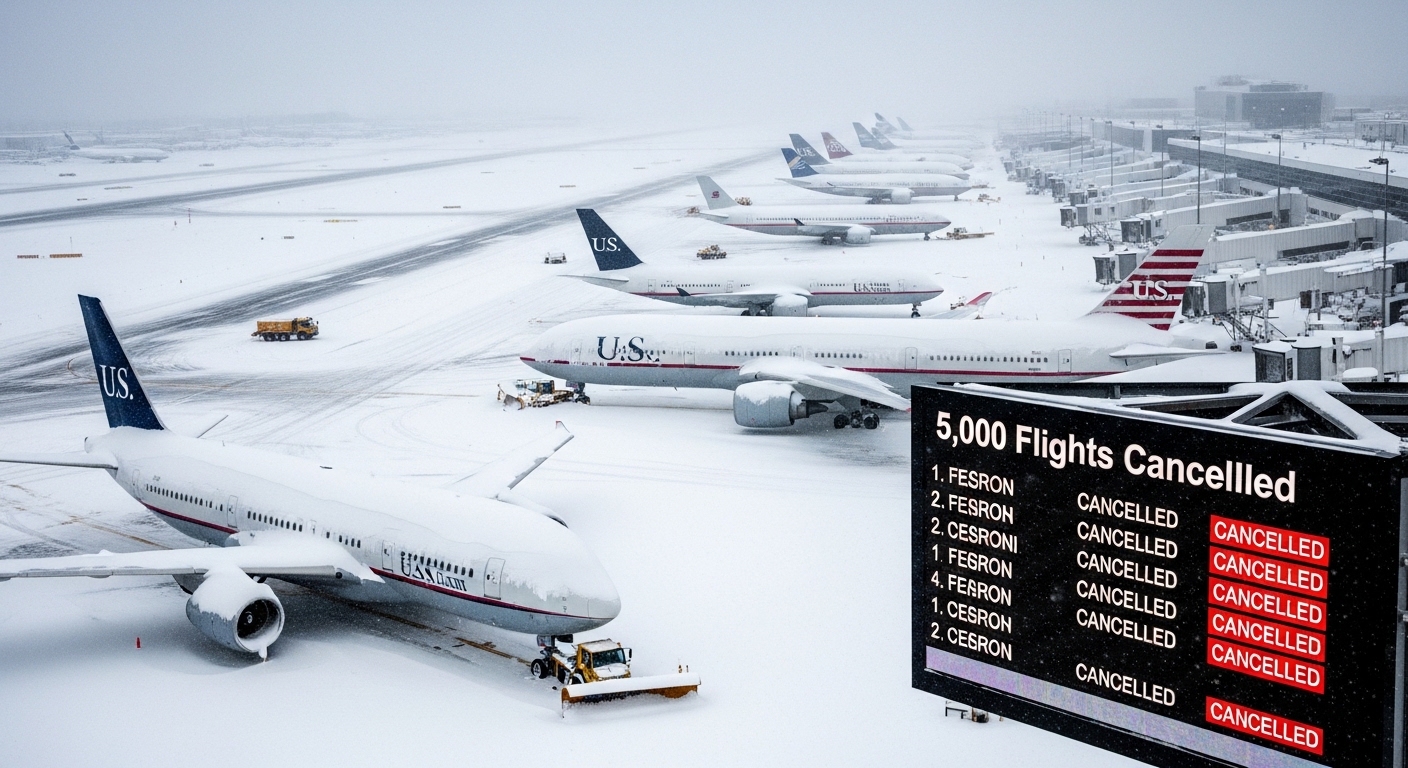
The East Coast of the United States is currently grappling with the aftermath of a historic and catastrophic US Snowstorm that began on Monday, February 23, 2026. This meteorological event has not only shattered decades-old snowfall records but has also brought the nation’s busiest travel corridors to a grinding halt. With over 5,000 flights cancelled and major metropolitan areas under strict emergency protocols, the storm represents one of the most significant winter weather disruptions in recent American history.
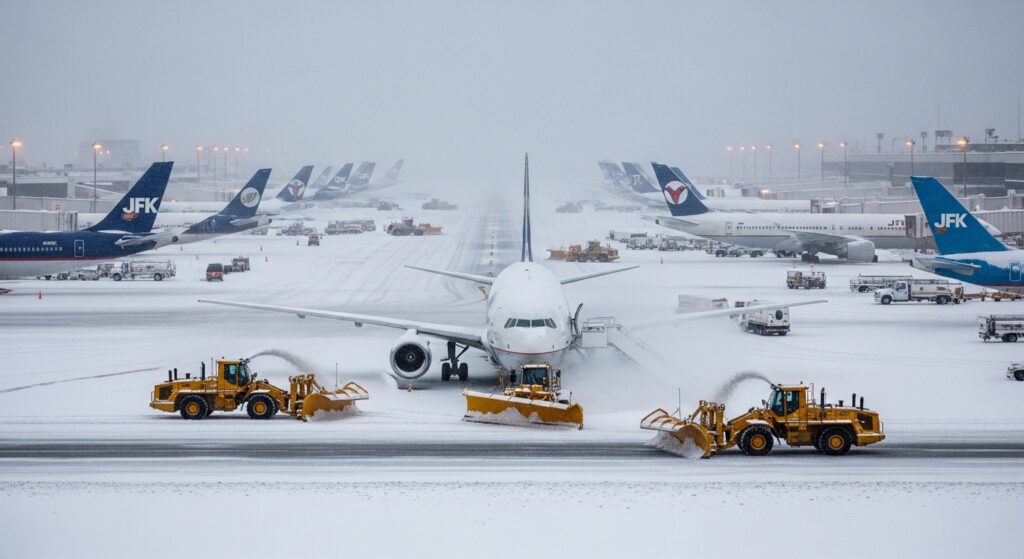
Unprecedented Aviation Disruptions and the US Snowstorm
According to data provided by the flight-tracking service Reuters (via FlightAware), the total number of flight cancellations within, into, or out of the United States surpassed 5,706 by late Tuesday. The impact was felt most acutely at the primary hubs of the Northeast. New York City’s aviation infrastructure faced a near-total blackout; 98% of flights from LaGuardia Airport and 91% from John F. Kennedy International Airport (JFK) were grounded.
JFK, which typically facilitates the movement of over 335,000 passengers daily, was rendered virtually silent as officials struggled to manage the rapid accumulation of snow. Similar scenes of gridlock played out in Boston, Newark, and Philadelphia, where airlines were forced to preemptively scrap schedules to ensure passenger safety. This US Snowstorm has highlighted the continued vulnerability of the nation’s transportation network to extreme weather events, a topic we have previously explored in our analysis of emerging global infrastructure challenges.
Record-Breaking Accumulation in New York and Rhode Island
The sheer volume of snow delivered by this system has stunned meteorologists. New York City recorded approximately 48 centimeters (19 inches) of snow, a figure that prompted Mayor Zohran Mamdani to declare a state of emergency. “The city has not faced a storm of this magnitude in over a decade,” Mamdani stated, urging residents to avoid all non-essential travel. The declaration included a temporary ban on all road travel, which effectively paralyzed the city of eight million people until the ban was partially lifted midday on Wednesday.
However, the most staggering figures emerged from Rhode Island, the nation’s smallest state. According to reports from the Associated Press, the capital city of Providence reported a snowfall height of 91 centimeters (36 inches). This total significantly eclipsed the previous record of 72.6 centimeters (28.6 inches) set during the legendary “Great Blizzard of 1978.”
“This is truly beyond the record books. We are as surprised as everyone else,” Candice Hrencecin, a meteorologist with the National Weather Service (NWS) in Boston, told the New York Times. The NWS noted that the rapid intensification of the storm, often referred to as a “bomb cyclone,” created localized “snow bands” that dumped several inches of snow per hour, making it impossible for road crews to keep up.
Social Impact and Emergency Response
The US Snowstorm did more than just disrupt logistics; it strained the social fabric of affected cities. In New York, despite the severity of the weather, incidents of civil friction were reported. The New York Police Department is currently investigating video footage from Washington Square Park showing individuals pelting officers with snowballs, an incident that highlights the tension inherent in enforcing city-wide lockdowns.
In neighboring Connecticut and Rhode Island, governors maintained strict travel bans well into Wednesday. The “stay-at-home” orders were essential to allow emergency vehicles and snowplows access to buried highways. Local media in Rhode Island described the conditions as “the worst in living memory,” with many residents trapped in their homes due to drifts that reached the second stories of some buildings.
The Impact on the Tri-State Area:
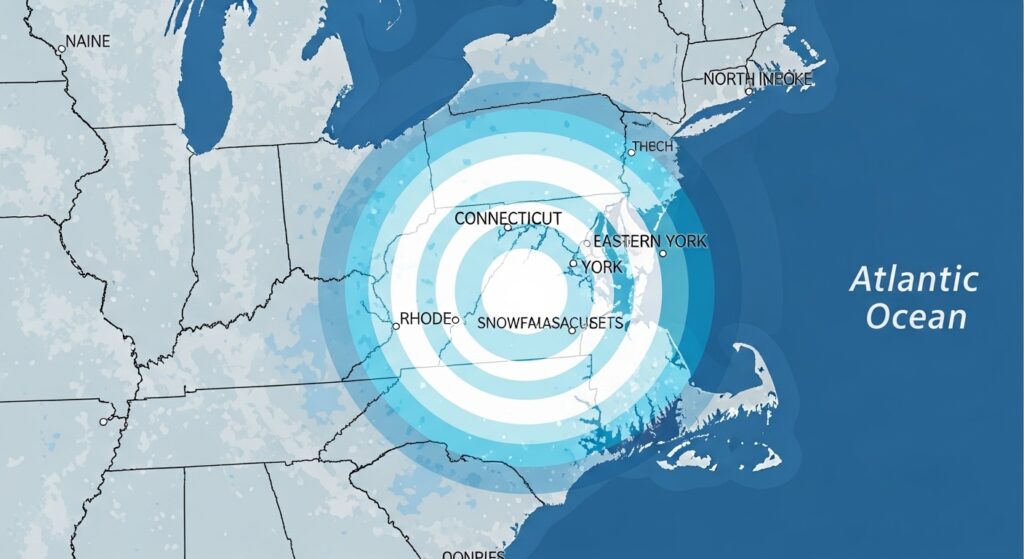
* New York (LGA/JFK): Near 100% flight cancellation rate; 48cm accumulation.
* New Jersey (Newark): Significant delays and cancellations; regional rail suspended.
* Pennsylvania (Philadelphia): Major disruptions to the Northeast Corridor rail line.
* Rhode Island (Providence): 91cm accumulation; record-breaking blizzard conditions.
Looking Ahead: Recovery and Economic Costs
As the storm begins to move out into the Atlantic, the focus shifts to recovery. However, the economic toll of this US Snowstorm is expected to be in the billions. Beyond the immediate losses to the aviation and hospitality industries, the “freeze” on commerce in the Northeast—a region that contributes significantly to the US GDP—will have lingering effects.
Airlines are now facing the monumental task of rebooking hundreds of thousands of displaced passengers. BBC News reports that while some runways have begun to reopen, the backlog of flights is expected to take at least a week to clear entirely. For now, the East Coast remains in a deep freeze, digging out from a storm that has rewritten the history books and served as a stark reminder of the power of nature.
Summary of the US Snowstorm (Feb 2026)
Total Flights Cancelled = 5,706+
Highest Snowfall = 91 cm (Providence, RI)
NYC Status = State of Emergency/Travel Ban
Previous Record Broken = Feb 1978 Blizzard (Rhode Island)
The political fallout of the response to the storm will likely be a subject of debate in the coming weeks, as officials examine whether the infrastructure was sufficiently prepared for such an extreme, albeit forecasted, event. For “The Global Ledger,” this remains a developing story on the intersection of climate, policy, and global mobility.