
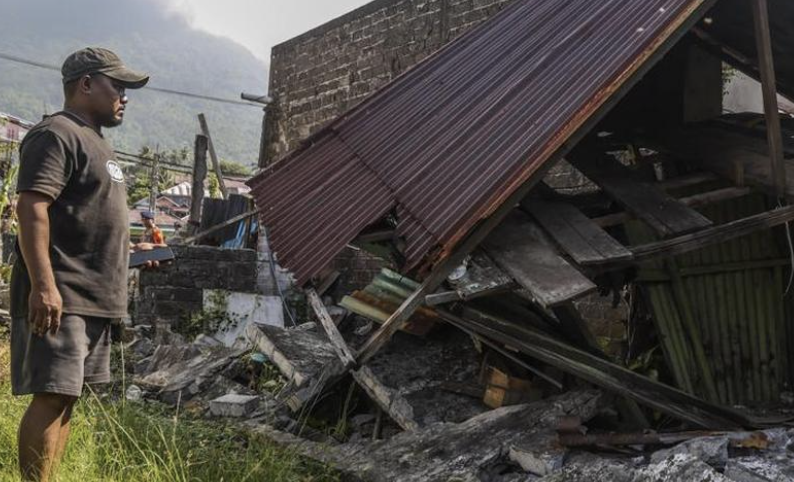
On Thursday morning, April 2, 2026, a powerful North Sulawesi Earthquake measuring M7.6 struck the waters southeast of Bitung, sending shockwaves across the province and triggering widespread alarm. While modern infrastructure faced its sternest test in years, the event did more than just rattle windows; it awakened the collective memory of a region defined by its volatile tectonic beauty. Residents in the highland city of Tomohon reported intense shaking that lasted nearly a minute, a duration that immediately drew parallels to the historical accounts of the famed British naturalist Alfred Russel Wallace, who documented a remarkably similar experience in the same hills more than 160 years ago.
The Science Behind the North Sulawesi Earthquake
According to the Meteorology, Climatology, and Geophysics Agency (BMKG), the epicenter was located at 1.25°N and 126.27°E, at a depth of 33 kilometers. Rahmat Triyono, Acting Director for Earthquakes and Tsunamis at BMKG, classified the event as a shallow crustal earthquake resulting from the complex subduction activity in the Molucca Sea. This region is a well-known tectonic laboratory where multiple plates converge, often leading to significant seismic releases.
Reports from Reuters indicate that while the epicenter was offshore, the geological composition of the Minahasa Peninsula amplified the vibrations. In Tomohon, situated on the slopes of Mount Mahawu, the “site effect” of volcanic soil meant that residents felt a more violent swaying than those on the harder rock of the northern coast. Although initial damage reports suggest only minor structural cracks in older buildings, the psychological impact was profound, as the community looked back to the annals of history to understand their current predicament.
Walking in Wallace’s Footsteps: The 1859 Parallel
The recent North Sulawesi Earthquake has reignited interest in the journals of Alfred Russel Wallace, the co-discoverer of the theory of evolution by natural selection. In his seminal work, The Malay Archipelago, Wallace provides a chillingly familiar account of a night in Tomohon. On June 29, 1859, while staying in the village of Rurukan, Wallace experienced a quake that mirrors the intensity of the 2026 event.
Wallace was sitting quietly reading at 8:15 PM when the ground began to heave. Initially dismissive, he soon found himself in the midst of a terrifying ordeal. He wrote that the wooden house he occupied shook so violently it felt as though it would collapse. The naturalist described a sensation akin to being “seasick,” a feeling many Tomohon residents echoed this week.
“The ground moves! The ground moves!” were the cries heard in 1859, as documented by BBC History archives. Wallace noted that upon returning to his room, his lamps were shattered and his spirits—specifically a bottle of arrack—were strewn across the floor. This historical continuity serves as a reminder that the people of North Sulawesi live in a landscape that is as culturally rich as it is geologically active.
The Rurukan Connection and the Wallace Line
Today, the village of Rurukan Satu honors this history with “Jalan Wallace” (Wallace Street). The village remains a hub for agrotourism, nestled at the base of Mount Mahawu. For the locals, the North Sulawesi Earthquake is not just a news headline but a part of their identity. Understanding the tectonic risks of the Indonesian archipelago is essential for the preservation of these historic highland communities.
The “Wallace Line,” which passes through the deep waters between Bali and Lombok and extends northward, marks the faunal transition between Asian and Australian species. However, it is the seismic “lines” of subduction that continue to shape the lives of those in Tomohon. Experts at The New York Times Science department have often highlighted how Wallace’s observations in the 19th century provided early clues into the dynamic nature of the Earth’s crust in Southeast Asia.
Modern Preparedness and Regional Seismicity
While Wallace had only his instincts and a sturdy wooden hut, today’s residents of Bitung and Tomohon benefit from early warning systems and stricter building codes. The Associated Press reported that local disaster management agencies (BPBD) conducted swift evacuations, and no tsunami was triggered due to the strike-slip component of the subduction movement.
However, the M7.6 North Sulawesi Earthquake serves as a potent reminder that nature’s cycles are long. The 167-year gap between Wallace’s “seasick” night and the 2026 tremors is but a blink in geological time. As North Sulawesi continues to develop as a tourism and maritime hub, the integration of historical data—like Wallace’s journals—with modern seismology remains a priority for regional safety.
As the dust settles in Rurukan and life returns to the agrotourism farms, the story of Alfred Russel Wallace remains more relevant than ever. The “Tanah Goyang” (Shaking Earth) is a permanent resident of the Minahasa highlands, a force that continues to bridge the gap between 19th-century exploration and 21st-century resilience.
For more updates on similar news and trending global stories, visit our latest news section.