Modern travelers often lament that the world is mapped to death. Every “hidden gem” now seems like a mere geotag. However, corners of the Indonesian archipelago still feel like a mystery. In the sapphire reaches of the Banda Sea, Romang and Damer Islands offer quiet isolation. Recent findings from a WWF Indonesia expedition have pulled back the curtain on this region. They reveal that Southwest Maluku biodiversity is a living time capsule of an ocean that once was.
For those who seek the authentic, these islands represent the final frontier. This isn’t the manicured beauty of a resort. Instead, it is the raw energy of a primary ecosystem functioning at its peak.
A Remote Corner of the Banda Sea Still Untouched
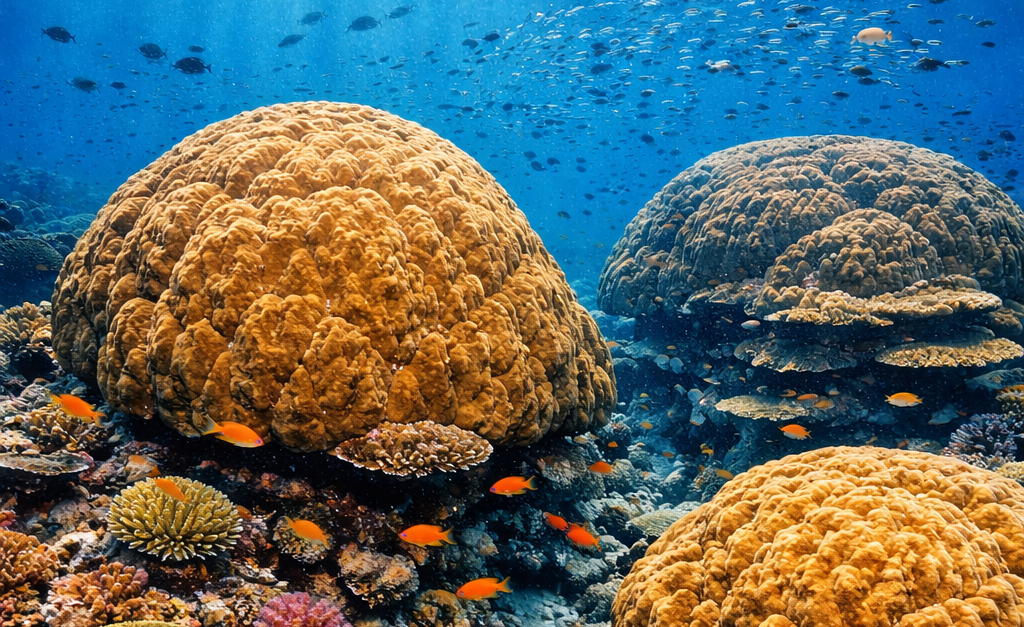
The expedition brought back data that reads like a love letter to the ocean. Ahmad Hafiz Adyas led the team as the Senior Manager of the WWF Indonesia Program. The researchers found that live coral cover fluctuates between 39% and 51%. In an era of global bleaching, these figures represent a sanctuary. Furthermore, the true story lies beneath the surface: the discovery of ancient “ancestor” corals.
Some of these massive structures are between 100 and 200 years old. Consequently, floating above them feels like visiting a silent historian. These corals have survived two centuries of shifting tides and temperature fluctuations. They remain the bedrock of the local ecosystem. Because they are structural architects, they provide a stable home for fish. This health supports local communities that rely on these waters for food.
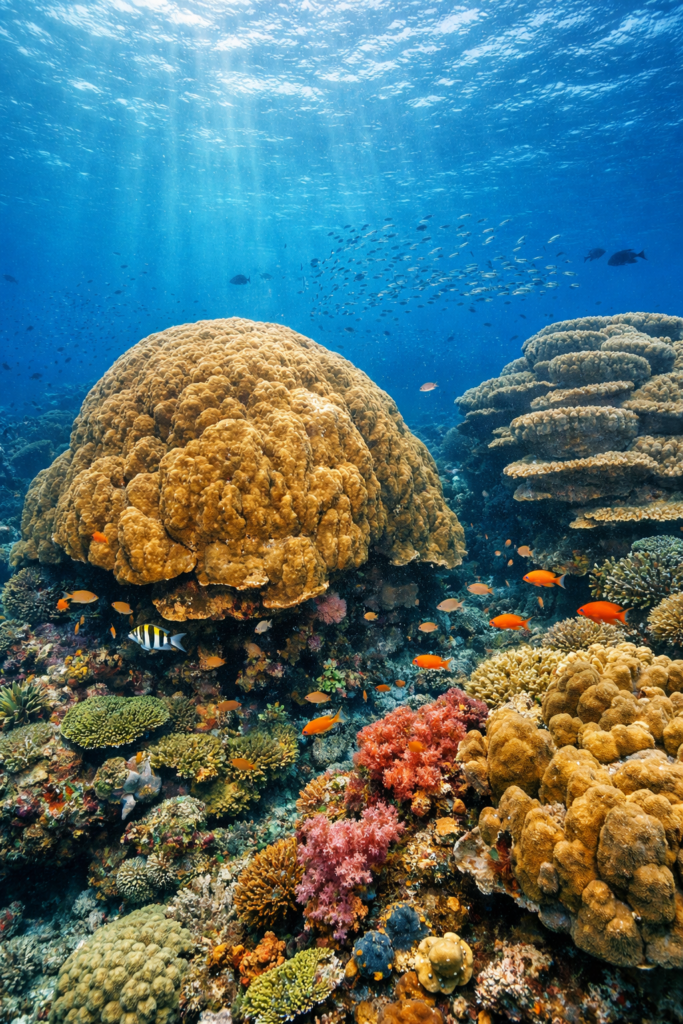
AI-generated illustration of
A vibrant underwater shot of massive ancestor corals in the Banda Sea
The Red Grass and the Mangrove Fortress
While corals are famous, the ecological sophistication of the region is found in its “blue carbon” nurseries. The expedition recorded a seagrass density of 57%. This is an astonishing figure. Most importantly, these waters hold two-thirds of all seagrass species found in Indonesia.
Among these is the Thalassodendirum ciliatum, a rare red-pigmented seagrass. This isn’t just a botanical curiosity. Its unique color indicates a specialized resilience to temperature changes. Therefore, it serves as a symbol of adaptation—nature’s own high-tech solution to a warming planet.
Nearby, the mangrove forests of Romang stand as a complete “fortress.” In many coastal areas, mangroves have been thinned out. In contrast, these exist in a perfect three-part structure. This vertical layering creates a nursery for marine life. It also acts as a barrier against erosion. It is a masterclass in natural engineering.
A Gathering of Marine Giants
The local wildlife are the residents of a very exclusive neighborhood. The WWF team documented a staggering array of “keystone species.” These are animals whose presence indicates a healthy environment. Sharks, turtles, and rays are common sights here. However, the expedition’s most thrilling encounters involved the heavyweights of the deep.
Researchers identified over 30 dugongs, which are increasingly rare across the globe. Their presence is a direct result of the pristine seagrass beds. Even more surprising was the sighting of Orcas. Finding these apex predators in tropical waters highlights a vital migratory corridor. When Orcas and Dugongs thrive, it signals that the entire ecological chain is intact. Protecting these “champion” species is a necessity for Southwest Maluku biodiversity.
The Evolution of the Luxury Experience
So what does this signal for the future of travel?
We are entering an era where luxury is no longer measured by excess or extravagance. For today’s travelers, the highest form of indulgence lies in authenticity—moments of quiet, untouched landscapes, and the rare privilege of breathing clean, natural air. Luxury is being redefined as the quality of the experience itself, not the price tag attached to it.
To explore how this mindset is reshaping global tourism, see our in-depth guide on [internal link: the rise of conservation travel].
The Southwest Maluku biodiversity narrative fits into a broader trend of “Conservation Travel.” This niche is for the conscious traveler or the digital nomad seeking a deep connection. We are the last generation that might see these places in their primordial state.
Indonesia must balance economic growth with stewardship. As they do, Romang and Damer stand as a blueprint. They remind us that the most valuable assets are often the ones we haven’t touched yet. To visit these islands is to participate in a vital story: the preservation of the Earth’s wild heartbeat.
For more Travel article, visit our
Travel