Modern supercars are, quite frankly, starting to become a bit of a bore. We live in an era where mid-engined layouts and aggressive aerodynamics have dictated a singular, homogenized profile for almost every flagship vehicle on the market. They are masterpieces of engineering, certainly, but they are also digital prisons—filled with genius-level traction control systems and active aero designed to manage power outputs that belong on a Richter scale rather than a public road. Driving them has become less about the art of the pilot and more about the management of a software suite. Thankfully, the newly unveiled Bertone Runabout has arrived to offer a visceral, analogue alternative to the tech-heavy status quo.
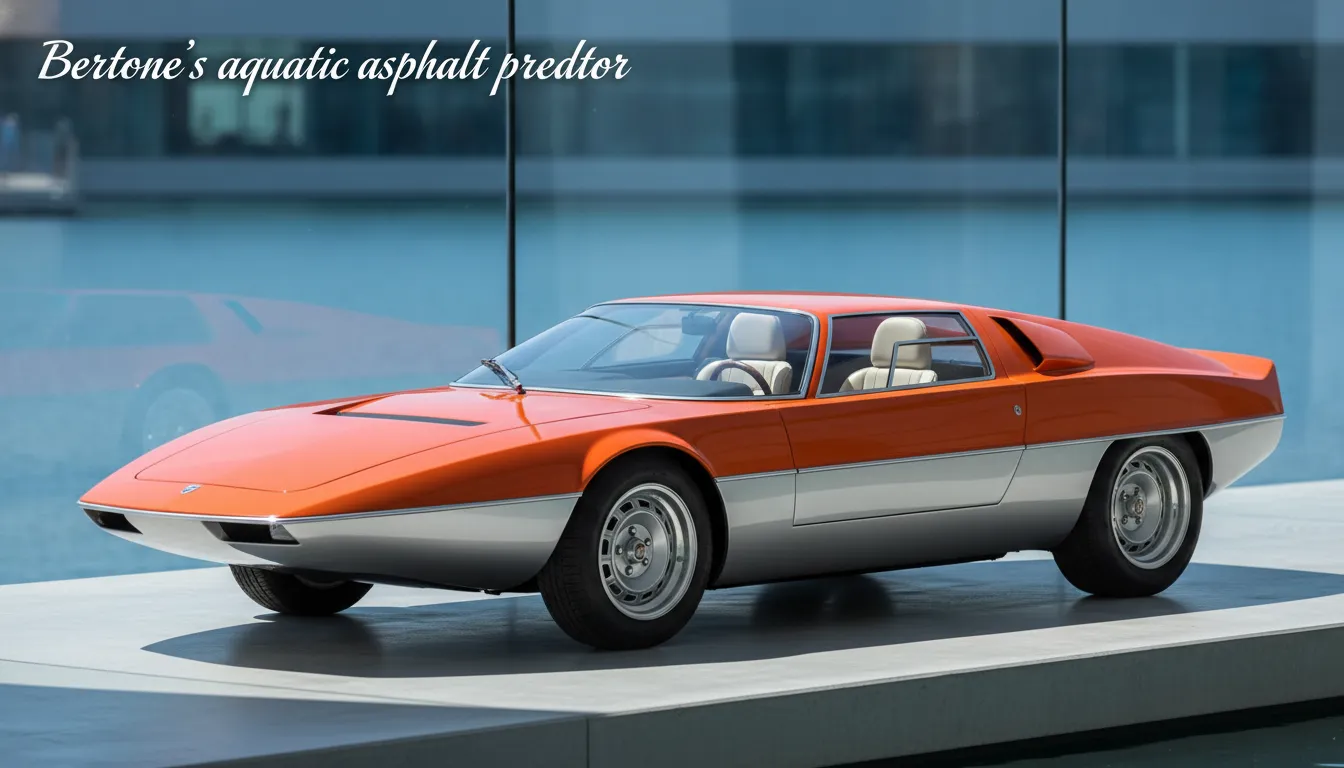
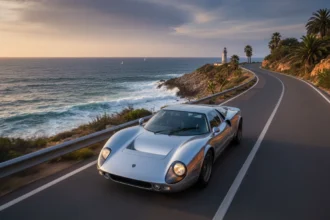
AI Generated Image: The Bertone Runabout Barchetta in its striking orange and silver livery, showcasing its speedboat-inspired wedge profile
The Design Legacy of the Bertone Runabout
The story of this car began over half a century ago at the 1969 Turin Motor Show. It was there that the legendary Marcello Gandini, working under the Bertone banner, penned the Autobianchi A112 Runabout concept. It was a “Neo-retro” masterpiece inspired by contemporary speedboats, featuring a pointed nose, a lack of doors, and a roll bar that looked like it belonged on a luxury yacht. That original concept eventually paved the way for the wedgetastic Fiat X1/9 and informed the radical geometry of the Lancia Stratos.
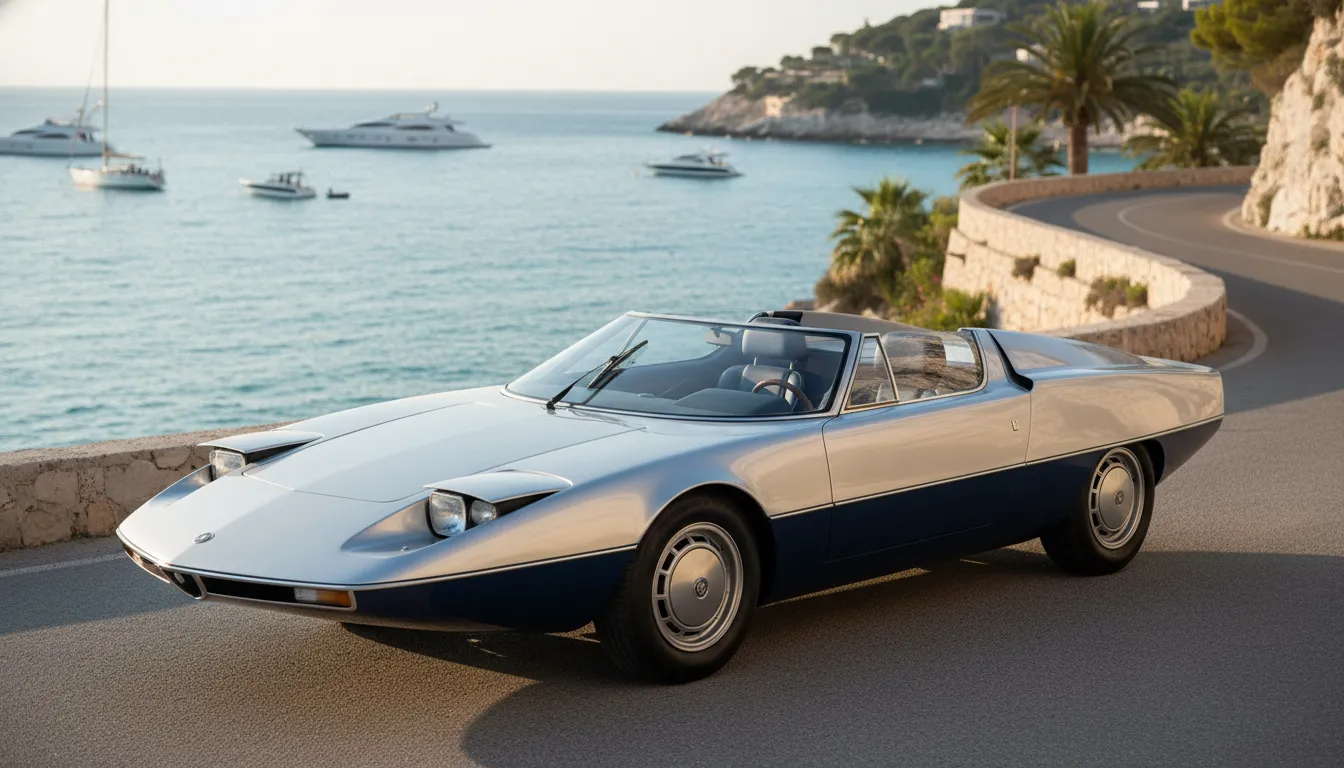
The modern Bertone Runabout isn’t just a tribute; it’s a refinement. It manages to look fitter rather than fatter, maintaining a dainty footprint that is increasingly rare in 2026. According to the designers at TopGear, the car avoids the “try-hard” aesthetic of many modern recreations, opting instead for a clean, rising swage line and iconic pop-up headlights that sit on the very edges of the nose. It feels fun, self-assured, and remarkably clean in an age of over-designed carbon fibre wings.
Barchetta vs Targa: Choosing Your Adventure
Bertone is offering the car in two distinct flavors. The Barchetta is the purest homage to the 1969 original, featuring a minimalist fly-screen and a permanently exposed cockpit. It’s a car for the Riviera, designed for those who don’t mind the wind in their hair and the occasional fly in their teeth. For the more practical-minded enthusiast, the Targa version offers a removable roof section, making it a viable companion for climates that involve actual weather. Both versions sit on staggered 18-inch front and 19-inch rear wheels, framed by arches that ape the original’s deep, central-focused radius.
Mechanical Guts: Lotus Bones and Toyota Power
Beneath that gorgeous Italian skin lies a mechanical soul that will be very familiar to purists. The Bertone Runabout is powered by a Toyota-sourced 3.5-litre supercharged V6, mid-mounted and tuned to produce a healthy 468bhp. If those specs sound familiar, it’s because the car utilizes an architecture very similar to the late-model Lotus Exige. However, Bertone is quick to point out that this isn’t a restomod or a simple re-body.
The chassis is a virgin item sourced from a specialist supplier and modified by Bertone, and each car carries a completely new VIN. Weighing in at just 1,150kg—roughly the same as an Alpine A110 but with a significantly larger set of lungs—the Runabout boasts a power-to-weight ratio that promises agility over brute force. As noted by technical reviews on Autocar, the use of an extruded and bonded aluminium chassis with adjustable damping ensures that the handling will be as sharp as the styling.
Why the Manual Transmission Matters
In a world of seamless dual-clutch gearboxes, Bertone has made the deliberate choice to fit a six-speed manual transmission with an exposed linkage. It’s a statement of intent. This car isn’t about chasing tenths of a second on a track; it’s about the tactile joy of the shift and the connection between the driver’s right foot and the rear wheels. For those interested in how this compares to other driver-focused machines, check out our guide to the best manual sports cars of the decade.
The Relaunch of the Bertone Brand
The return of the Bertone Runabout marks a significant chapter in the revival of one of Italy’s most storied design houses. Founded in 1912 by Giovanni Bertone, the company began by making horse-drawn carriages before becoming a powerhouse of automotive design under “Nuccio” Bertone. The brand was recently revived by the Ricci brothers, who are steering the marque away from mass production and toward ultra-limited, high-concept vehicles like the GB110 and now the Runabout.
As Car and Driver has frequently highlighted, the market for “boutique” supercars is exploding, but few have the genuine heritage that Bertone brings to the table. By tapping into their back catalogue of “rockstar” designers like Gandini and Giugiaro, Bertone is offering something that even MotorTrend enthusiasts can agree is missing from the modern market: character.
With only 25 units slated for production, the Bertone Runabout is destined to be a rare sight. While some will undoubtedly end up in climate-controlled collections, the car’s mechanical simplicity and Lotus-derived DNA suggest it was built for the road. It is a reminder that you don’t need 1,000 horsepower or a “gigabrain” AI to have a supercar experience. Sometimes, all you need is a supercharged V6, a manual gearbox, and a design that makes you smile every time you open the garage door. As the team at Jalopnik often argues, the best cars are the ones that prioritize the “fizz” over the figures, and the Runabout has fizz in spades.