As the shadow of conflict lengthens across the Middle East, the demand for long-term survival solutions is reaching a fever pitch. With the escalating “shadow war” between Israel, the United States, and Iran threatening to spill into a broader regional conflagration, the concept of the “end-times retreat” has transitioned from fringe paranoia to a calculated real estate investment. At the center of this shift are the Vivos doomsday bunkers, a massive network of hardened shelters designed to withstand everything from nuclear strikes to societal collapse.
Democratizing Survival: The Vivos Doomsday Bunkers Approach
Traditionally, the “prepper” industry has been viewed as a playground for Silicon Valley billionaires and the ultra-wealthy. However, the current geopolitical climate—marked by volatile rhetoric and direct military exchanges—has shifted the demographic. Dante Vicino, Executive Director of Vivos, notes that the interest in Vivos doomsday bunkers is now coming from the “everyman.”
“Our members range from middle-class families to high-net-worth individuals,” Vicino stated in a recent interview. The company’s flagship project, Vivos xPoint, is located in the Black Hills of South Dakota. It is marketed not as a luxury resort for the 1%, but as a life insurance policy for humanity. According to reports from Reuters, the surge in global instability has led to a 300% increase in inquiries for private shelters over the last eighteen months.
From Military Outpost to Modern Sanctuary
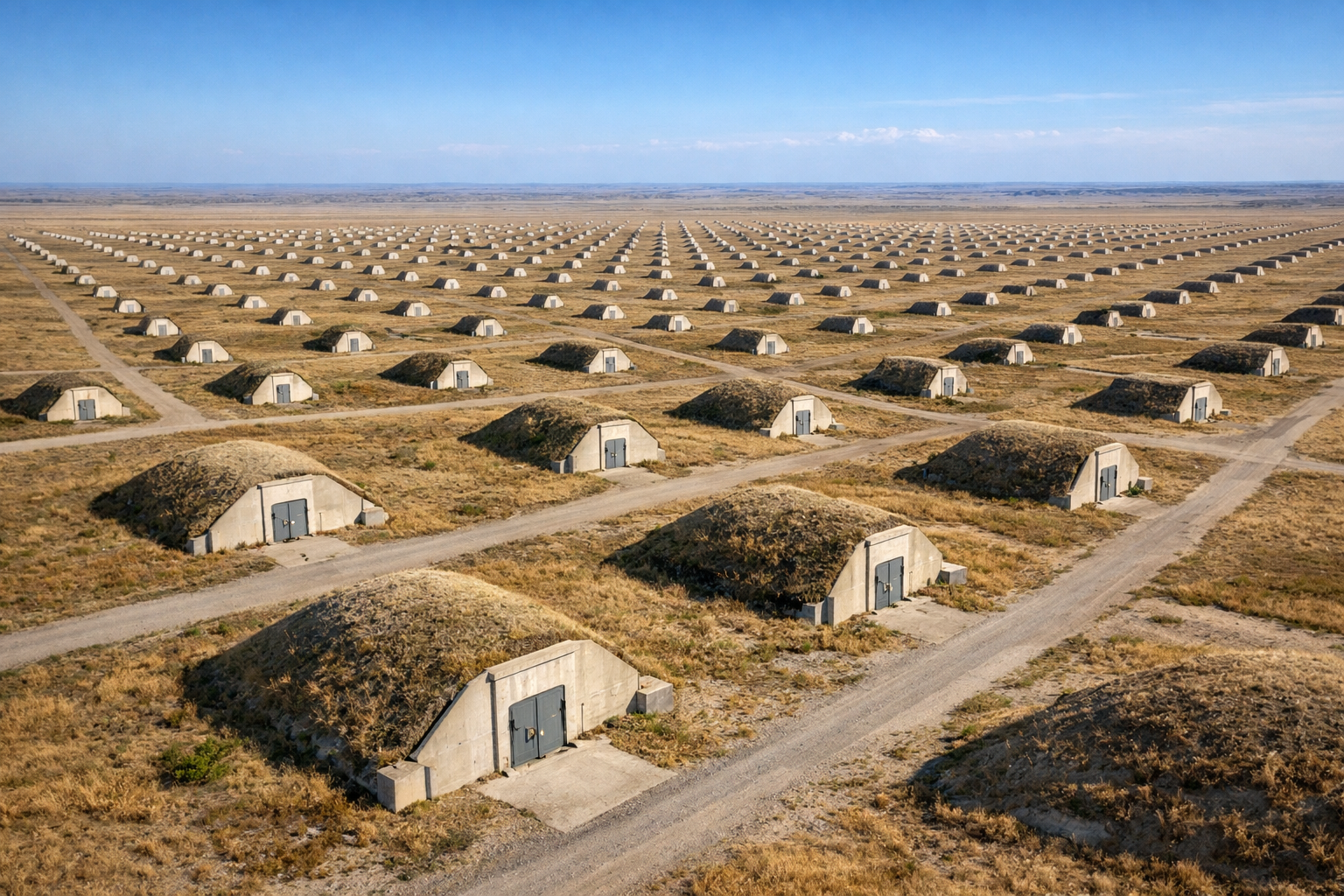
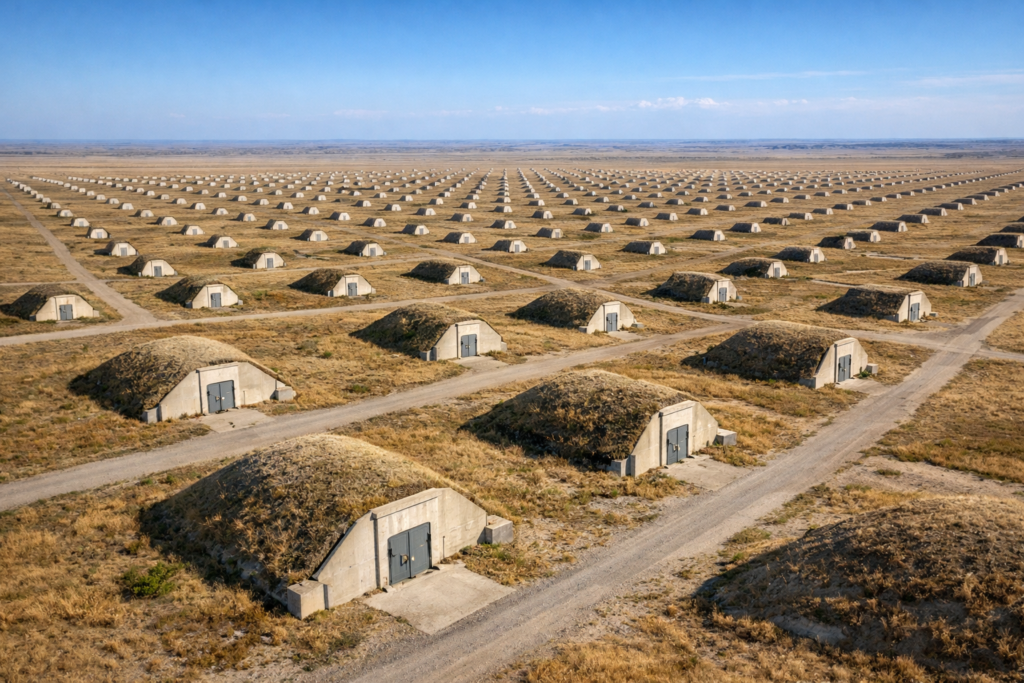
The South Dakota facility is a marvel of repurposed military engineering. Originally built by the Army in 1942 as the Fort Igloo munitions depot, the site consists of 575 hardened concrete bunkers. These structures were designed to withstand a massive internal explosion, making them ideal for external protection against the “worst-case scenarios” currently being discussed in the halls of the Pentagon and the Kremlin.
Each of the Vivos doomsday bunkers is buried under thick layers of earth and features a massive steel blast door. While the exteriors remain rugged and inconspicuous, the interiors can be customized to include high-end kitchens, medical suites, and even hydroponic gardens. For those looking to understand the broader context of these facilities, our analysis of global security trends provides deeper insight into why domestic preparedness is hitting record highs.
Why Geopolitical Instability is Driving the Bunker Market
The primary catalyst for the renewed interest in Vivos doomsday bunkers is the deteriorating relationship between Western powers and the Iranian-led “Axis of Resistance.” As noted by the BBC, the risk of a miscalculation in the Strait of Hormuz or a direct strike on nuclear facilities has reached its highest point in decades.
This “new Cold War” feel has resurrected anxieties not seen since the 1960s. However, unlike the backyard fallout shelters of the past, modern survivalists are looking for community-based solutions. Vivos markets its facilities as “Darwinian communities,” where members are vetted based on their skills—doctors, engineers, and teachers are highly valued—to ensure that if the surface world becomes uninhabitable, the subterranean one can thrive.
Life Underground: What’s Inside a Vivos Shelter?
Surviving a global catastrophe requires more than just thick walls. The Vivos doomsday bunkers are equipped with off-grid power systems, deep-water wells, and advanced air filtration systems (HEPA) designed to scrub out biological, chemical, and nuclear particulates.
- Self-Sufficiency: Facilities include massive fuel storage and solar arrays.
- Security: The xPoint facility is a gated, 24/7 guarded community larger than the size of Manhattan.
- Longevity: Supplies are typically cached to last a minimum of one year without surface contact.
As the New York Times has reported, the “prepping” industry is now a multi-billion dollar sector. What was once seen as an extreme reaction to world events is increasingly being viewed as a pragmatic response to an unpredictable world.
The Future of the “Survival Investment”
As we move further into 2025, the narrative surrounding Vivos doomsday bunkers continues to evolve. It is no longer just about “if” a disaster happens, but “when” and “how” one is prepared. For the residents of Vivos, the investment isn’t just in concrete and steel; it’s an investment in the continuity of their families.
While critics argue that such facilities provide a false sense of security, the buyers—ranging from suburban parents to corporate executives—seem to disagree. In an era where a single drone strike can shift the global economy, having a “Plan B” located 30 feet underground in South Dakota is becoming a very popular insurance policy.
For more updates on global security and the evolving landscape of international relations, stay tuned to The Global Ledger as we monitor the developing situation in the Middle East and its impact on domestic policy.
For more updates on similar news and trending global stories, visit our latest news section.