
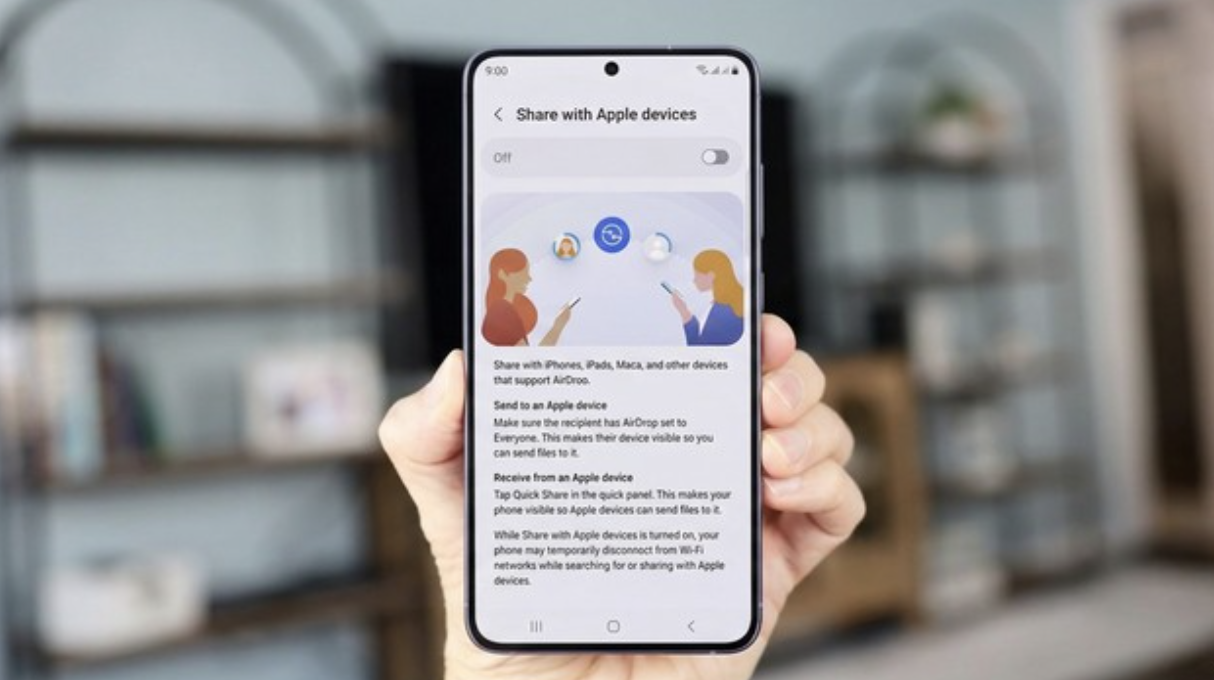
The long-standing wall between Android and iOS has finally developed a significant crack. Samsung has officially confirmed that the newly released Galaxy S26 series will support cross-platform file sharing with Apple devices, including the iPhone, iPad, and Mac. This move, which leverages an updated version of Samsung’s Quick Share, allows users to send and receive high-resolution photos, 4K videos, and large documents seamlessly without the need for third-party apps like WhatsApp or Telegram, which often compress media quality. By adopting a protocol that is natively compatible with Apple’s AirDrop, Samsung is addressing one of the most persistent pain points for consumers living in mixed-device households.
Breaking the Walled Garden: How the Galaxy S26 Changes Everything
For over a decade, the “walled garden” has been the primary strategy for both Samsung and Apple. However, the tide began to turn in late 2025. This latest development follows the path blazed by Google, which introduced similar interoperability with the Pixel 10 series in November 2025. At the time, industry analysts viewed Google’s move as a response to increasing regulatory pressure in the European Union and a maturing market where hardware specs have plateaued, leaving user experience as the final frontier.
The Galaxy S26 is among the first wave of non-Google devices to adopt this universal sharing standard. During the Galaxy Unpacked 2026 event in San Francisco, Samsung emphasized that this wasn’t just about utility—it was about “intuitive connectivity.” By making Quick Share compatible with the AirDrop protocol, Samsung is effectively removing the “social tax” often associated with owning an Android device in regions where the iPhone dominates the cultural landscape.
The Technical Wizardry Behind Cross-Platform Quick Share
Many users might wonder how two historically incompatible systems are suddenly talking to one another. The technology relies on a combination of Bluetooth Low Energy (BLE) for discovery and a peer-to-peer Wi-Fi connection for the actual data transfer. While Apple has kept AirDrop proprietary for years, the industry-wide push for the “Matter” smart home standard and the adoption of RCS messaging seems to have paved the way for more open wireless protocols.
To use the feature on your Galaxy S26, the process is remarkably straightforward:
1. Open the “Quick Share” menu from your Quick Settings panel.
2. Toggle on the new “Universal Sharing” or “AirDrop Compatibility” mode.
3. Select the file you wish to send and tap “Share.”
4. The nearby iPhone will appear in the device list just like another Galaxy device.
Samsung has noted that the rollout will begin on March 23, starting in South Korea, before expanding to North America, Europe, and Southeast Asia. This staggered release allows Samsung to monitor the security implications of opening up its file-sharing system to external ecosystems.
Why Interoperability is the Real Winner for Consumers
From a consumer impact perspective, this is the most significant software update in years. As noted by The Verge’s previous coverage of ecosystem locks, the inability to share full-quality media has often forced families into choosing one platform over another. With the Galaxy S26 bridge, that pressure is significantly reduced.
According to reports from TechCrunch, this move could also signal a shift in how Apple views its own proprietary services. If Android manufacturers can successfully emulate the AirDrop experience, the “lock-in” effect of the iPhone weakens, forcing Apple to innovate further on hardware and services rather than relying on ecosystem barriers.
Furthermore, Samsung has confirmed that this isn’t just a flagship exclusive. While the Galaxy S26 is the hero device for this launch, the company plans to bring AirDrop-compatible Quick Share to older Galaxy models through a series of software updates throughout 2026. This democratization of technology is a win for the circular economy, as it keeps older devices relevant in a cross-platform world.
Looking Ahead: The Future of Mobile Ecosystems
The arrival of the Galaxy S26 with these capabilities marks the beginning of what many are calling the “Open Mobile Era.” We are seeing a trend where the hardware you carry matters less than the services you can access. Deep dives from Wired suggest that we may soon see similar moves in the realms of cross-platform clipboard sharing and even unified backup solutions.
For now, the Galaxy S26 stands as a testament to a changing industry. It is a device that no longer asks you to choose between a superior camera and the ability to send a video to your friends. As these features roll out globally this month, the “green bubble vs. blue bubble” war might not be over, but the “can you email that photo to me?” era is officially coming to an end.
Discover the latest technology news, reviews, and trends by exploring our coverage here.