The Toyota MR2 redefined what a mass-market manufacturer could achieve when it stopped worrying about Corolla sales and started obsessing over physics. While the world viewed Toyota as a purveyor of sensible family transport, the Mk1 MR2 arrived like a lightning bolt from a clear sky. It wasn’t just a mid-engine commuter; it was a high-revving, wedge-shaped middle finger to the status quo that proved Japan could out-engineer the Europeans at their own game.
Toyota MR2 Secrets: The Group B Monster That Never Was
Most enthusiasts recognize the AW11 as a street-legal scalpel, but few realize Toyota nearly unleashed a terrifying version of this car on the world’s rally stages. In 1985, Toyota Motorsport GmbH (then TTE) began developing the “222D” prototype. This was no mere engine swap. Engineers stuffed a 750bhp turbocharged powerhouse into a chassis weighing just 750kg, aiming for a 1:1 power-to-weight ratio that would make a modern Koenigsegg sweat.
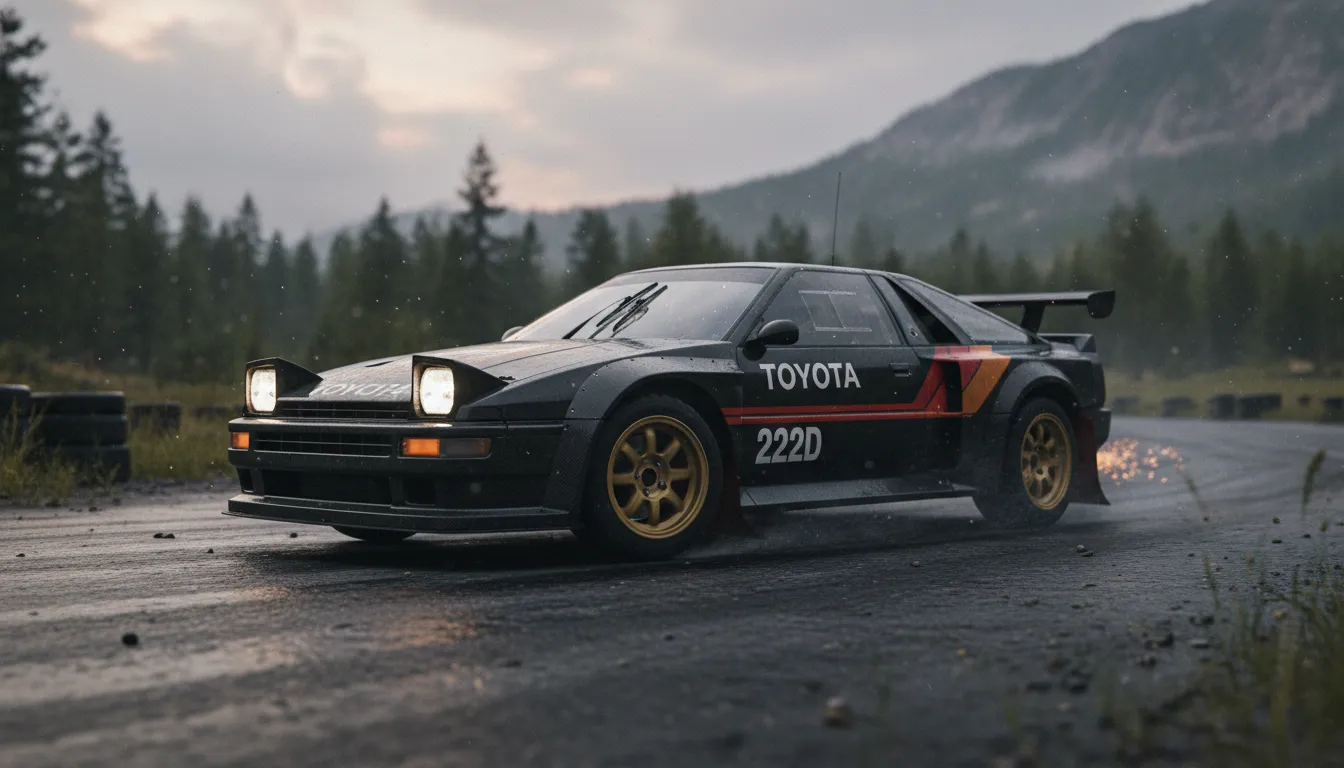
The black Toyota 222D Group B prototype showing its widebody stance
The 222D featured an experimental all-wheel-drive system and a longitudinal engine layout, departing from the street car’s transverse setup. It represented Toyota’s bid for Group B dominance, but the FIA’s sudden cancellation of the series following several fatalities consigned the project to the history books. You can find more about these lost prototypes at Top Gear, where the 222D remains a haunting “what if” in motorsport history.
The Lotus Connection and Handling Prowess
The legendary handling of the Mk1 isn’t a happy accident. Toyota famously hired Lotus to assist with the chassis development. Roger Becker, the legendary Lotus suspension guru, spent countless hours finessing the MR2’s geometry. This collaboration explains why the car feels so telepathic. While a contemporary Toyota AE86 offers driftable charm, the MR2 provides surgical precision.
Lotus engineers ensured the MacPherson struts at all four corners worked in harmony with the car’s low polar moment of inertia. This creates a driving experience where the car rotates around the driver’s hips. According to historical data from Car and Driver, the original MR2 out-handled cars twice its price, proving that balance always beats brute force.
The Heart of the Beast: The 4A-GE Engine
At the center of the MR2 experience sits the 1.6-litre 4A-GE inline-four. This twin-cam masterpiece features a 16-valve head developed in partnership with Yamaha. It delivers 122bhp, which sounds modest today, but in a car weighing exactly one tonne, it feels electric. The engine thrives on revs, pulling healthily toward a 7,500rpm redline with a metallic rasp that modern turbocharged units cannot replicate.
Toyota’s T-VIS (Toyota Variable Induction System) optimizes airflow at both low and high RPMs, ensuring the engine feels punchy across the entire range. This powerplant didn’t just move the car; it sang. It transformed every trip to the grocery store into a qualifying lap.
1980s Design and Fighter Jet Ergonomics
The aesthetic of the Mk1 Toyota MR2 celebrates the straight line. In an era before wind tunnels dictated every curve, the MR2 embraced the wedge. It looks like something drawn with a T-square and a heavy dose of futurism. Inside, the “fighter jet” cockpit places every critical control within finger-reach of the steering wheel.
Chunky rotary switches mounted on binnacles allow the driver to adjust lights and wipers without moving their hands from the 9 and 3 positions. This ergonomic focus puts many modern touchscreens to shame. The cabin consists of hard plastics and angular boxes, yet it feels purposeful rather than cheap. It reminds you that this car exists for the act of driving, not for the luxury of lounging.
Why the Market is Exploding
For years, the second-generation “SW20” MR2 overshadowed the original Mk1. Buyers preferred the mini-Ferrari looks of the 90s model. However, the market is shifting. Collectors now crave the raw, unfiltered experience of the AW11. The Mk1 offers a purity that later, heavier models lost.
According to recent pricing analysis from Autocar, clean examples of the Mk1 are reaching record highs at auction. The car represents the peak of 1980s Japanese engineering—a time when Toyota took massive risks to prove they could build more than just reliable appliances.
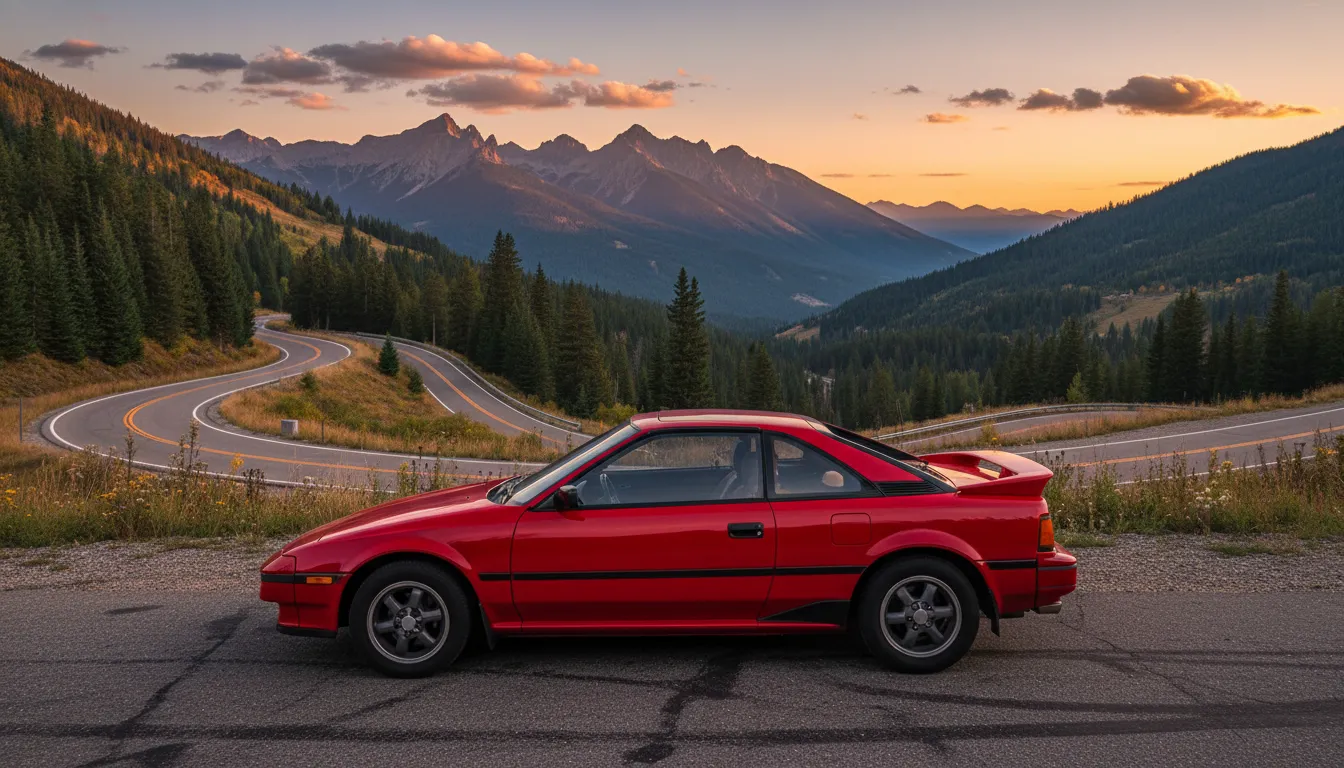
Side profile of a red Toyota MR2 Mk1 parked on a mountain pass
Driving the Legend Today
Stepping into a 40-year-old MR2 today reveals how much modern cars have insulated us from the road. The steering, unassisted and heavy at low speeds, lightens into a vibrational masterpiece once you’re moving. You feel every pebble, every change in camber, and every hint of grip.
The five-speed manual gearbox features a “thumbs up” shaped lever that snicks into gear with mechanical honesty. Unlike the vague shifters found in modern hatchbacks, the MR2 feels connected. It urges you to push harder, to brake later, and to trust the mid-engine balance. While the Fiat Coupe Turbo of the same era might try to torque-steer you into a ditch, the MR2 simply grips and goes.
Toyota proved that a sports car didn’t need a massive V8 or a prestigious European badge to be world-class. It just needed a brilliant chassis, a rev-happy engine, and the courage to be different. The Mk1 MR2 isn’t just a classic; it’s a blueprint for what a driver’s car should be.