The Bugatti Veyron Secrets involve a level of corporate ambition that borders on the impossible. When Ferdinand Piëch decided to resurrect a legendary French marque, he didn’t just want a fast car; he demanded a machine that defied every established law of thermodynamics and aerodynamics. Most manufacturers start with a chassis or an engine, but Piëch started with a sketch on a Japanese train and a set of performance figures that made his engineers tremble. This is the story of how a candlestick, an 18-cylinder dream, and sheer boardroom intimidation birthed the fastest car in the world.
How Bugatti Veyron Secrets Defined Modern Performance Engineering
Ferdinand Piëch possessed an obsession with cylinder counts that bordered on the fanatical. Before the world ever saw a W16, Piëch dreamed of an 18-cylinder monster. He drew the initial concept on the back of an envelope while traveling on a Shinkansen train in 1997. This wasn’t a whim; Piëch had carried this obsession since his days at Porsche in the 1970s. He even kept a redundant 16-cylinder crankshaft as a candlestick in his home—a constant reminder of unfinished business.
When Volkswagen acquired the rights to Bugatti from Romano Artioli, the path to production hit an immediate snag. Lawyers spent months annulling bizarre licensing deals for Bugatti-branded “tat,” including sunglasses and perfumes. This delay allowed Giugiaro to secretly build the EB118 concept. By the time the TopGear team first saw the Veyron 18/4 in Tokyo, the automotive world knew something massive was brewing.
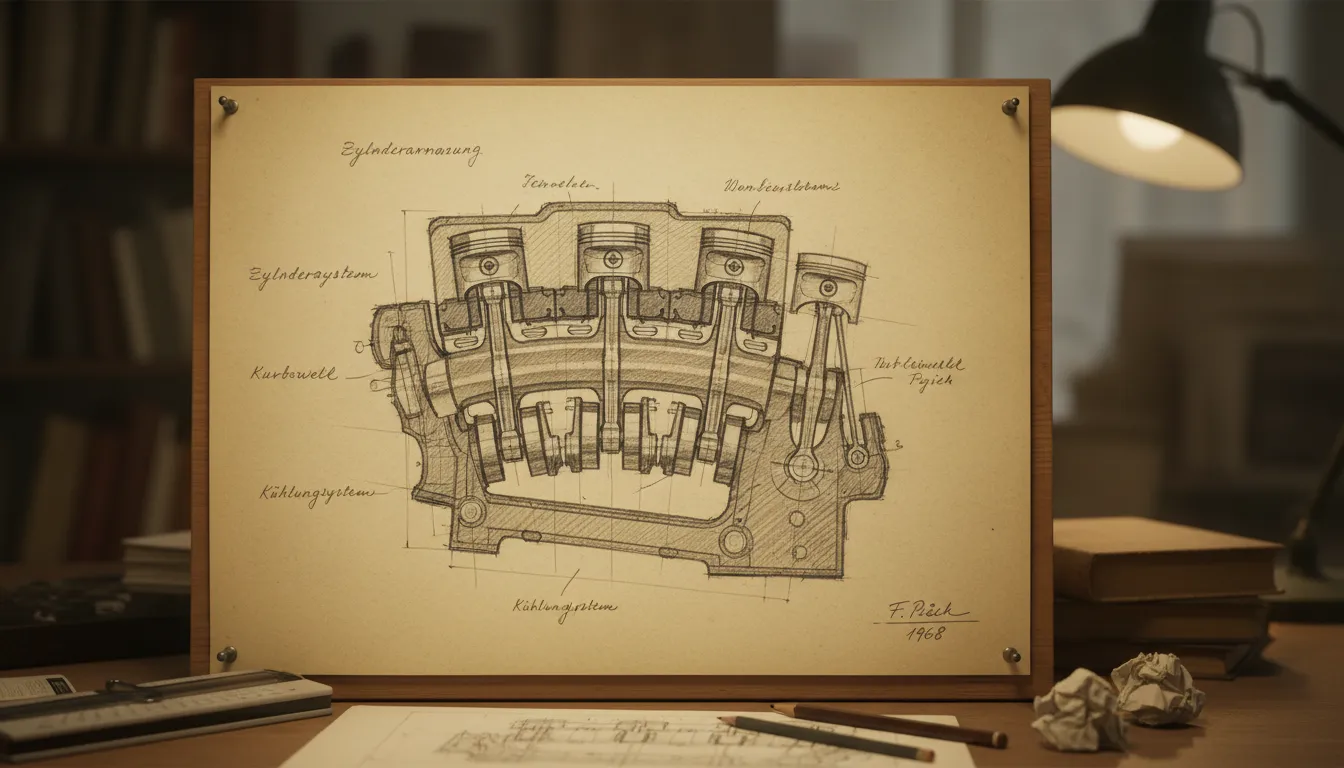
AI Generated Image: The original 18-cylinder engine sketch by Ferdinand Piëch
The 1,001 Horsepower Ultimatum
At the 2000 Geneva Motor Show, Piëch dropped a bombshell that the industry viewed as a suicide mission. He announced the Veyron would produce exactly 1,001 horsepower, reach 250 mph, and remain comfortable enough for a trip to the opera. Engineers soon realized that the 18-cylinder engine, essentially six three-cylinder Lupo engines joined together, could only manage 555 bhp. To hit the target, they had to pivot.
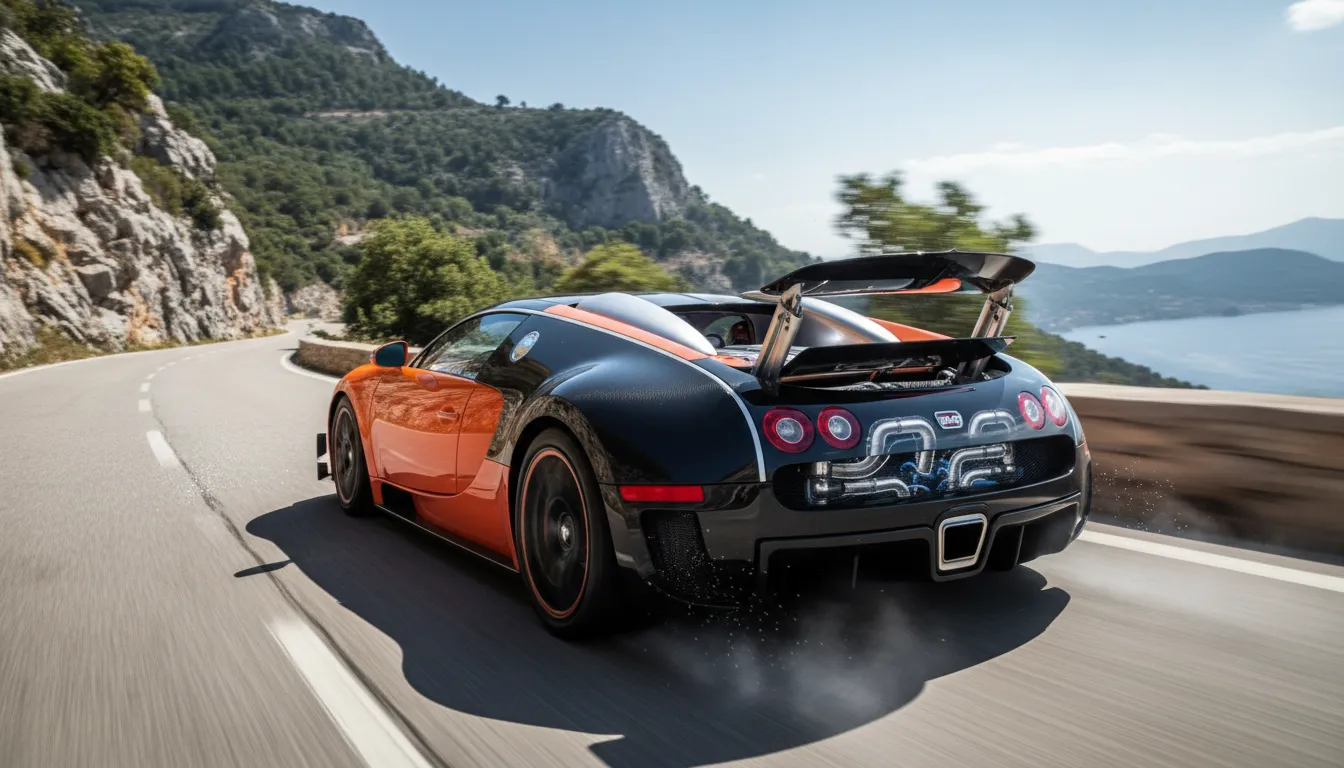
The solution involved mating two Passat W8 engines end-to-end, creating the 8.0-liter W16. Adding four turbochargers provided the necessary grunt, but it created a heat management nightmare. The car required ten radiators just to keep from melting itself into the pavement. This back-to-front development—setting the performance targets before building the engine—nearly broke the Volkswagen Group’s engineering department.
The Steering Crisis and Laguna Seca Spin
By 2003, the project looked like an expensive albatross. While the McLaren F1 remained the benchmark for purity, the Veyron struggled with its own identity. Bernd Pischetsrieder, who replaced Piëch as VW Group chairman, hated the car’s initial handling. He found the steering too slow compared to his Ferrari Enzo. He demanded a change in the steering ratio from 20:1 to 18:1, a move that required a total suspension overhaul.
Public embarrassment followed. In August 2003, a Veyron prototype spun in front of a crowd at the Laguna Seca historic meeting. Rumors of “junk” engineering began to circulate in the press. Karl-Heinz Neumann, the powertrain chief, fought back against the media, showing graphs of perfect cooling performance while secretly hiding the fact that a prototype had just grazed a barrier at Nardo at 236 mph.
Aerodynamics: Preventing the Flying Car
Engineers identified aerodynamics as the single greatest hurdle. At 250 mph, a car doesn’t want to stay on the road; it wants to become a wing. According to Neumann, the team spent thousands of hours in the wind tunnel to ensure the car wouldn’t “fly.” They developed a hydraulic rear wing that adjusted its angle based on speed, providing 100kg of downforce at the rear.
The weight became a secondary but equally daunting issue. Despite using carbon fiber and aluminum, the luxury requirements—thick leather, a Burmester stereo, and heavy soundproofing—pushed the weight to nearly two tons. Critics at Autocar questioned how such a heavy machine could compete with the lightweight Porsche Carrera GT.
The Final Validation
The Veyron finally reached the press in 2005, two years late and millions over budget. Any skepticism vanished the moment the throttle hit the floor. Gordon Murray, the man behind the McLaren F1, admitted the car blew him away despite its massive weight. The Veyron didn’t just meet Piëch’s targets; it crushed them.
When Jeremy Clarkson raced the Veyron against a plane across Europe, the car’s dual nature became clear. It could headbutt the laws of physics on the autostrada and then weave through the narrow passes of the Alps with exquisite grace. It proved that Piëch’s “upside-down” development process, while agonizing for the engineers, resulted in a machine that changed the industry forever. You can read more about its mechanical legacy at Car and Driver.
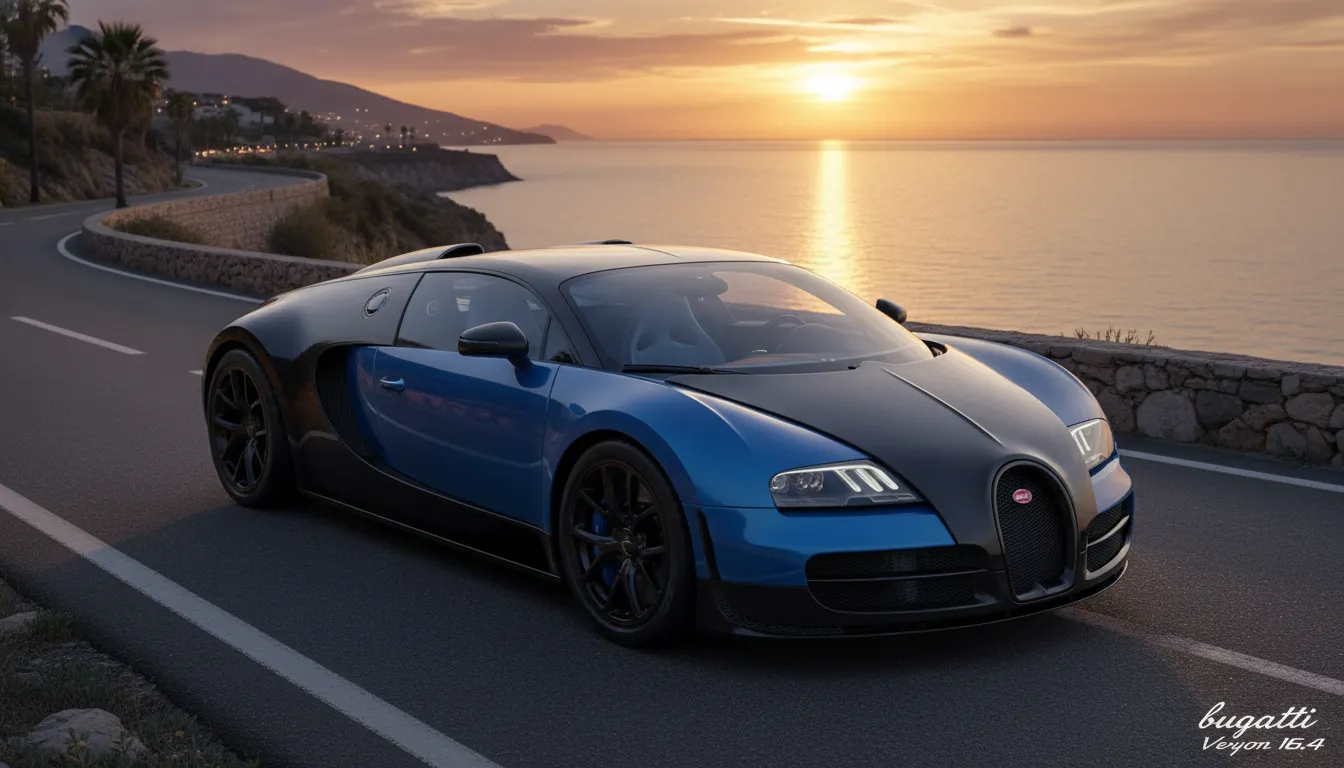
Bugatti Veyron 16.4 in its signature blue-on-black livery
The Legacy of the Albatross
The Volkswagen Group insiders once suggested capping production at 50 units to mitigate losses. Instead, they built 300 coupes and several variants, proving that there was indeed a market for a multi-million-dollar hypercar. The Veyron wasn’t just a car; it was a statement of technical supremacy. It moved Bugatti from a defunct historical footnote to the pinnacle of the Volkswagen Group’s portfolio, paving the way for the Chiron and the Bolide.
Piëch’s willingness to use fear as a management tool ensured that his engineers never settled for “good enough.” They solved the impossible puzzle of fitting 1,001 horsepower into a luxury wrapper that anyone could drive to the opera. The Veyron remains the definitive proof that with enough money, ego, and engineering brilliance, even the most outrageous sketches on a train can become reality.