
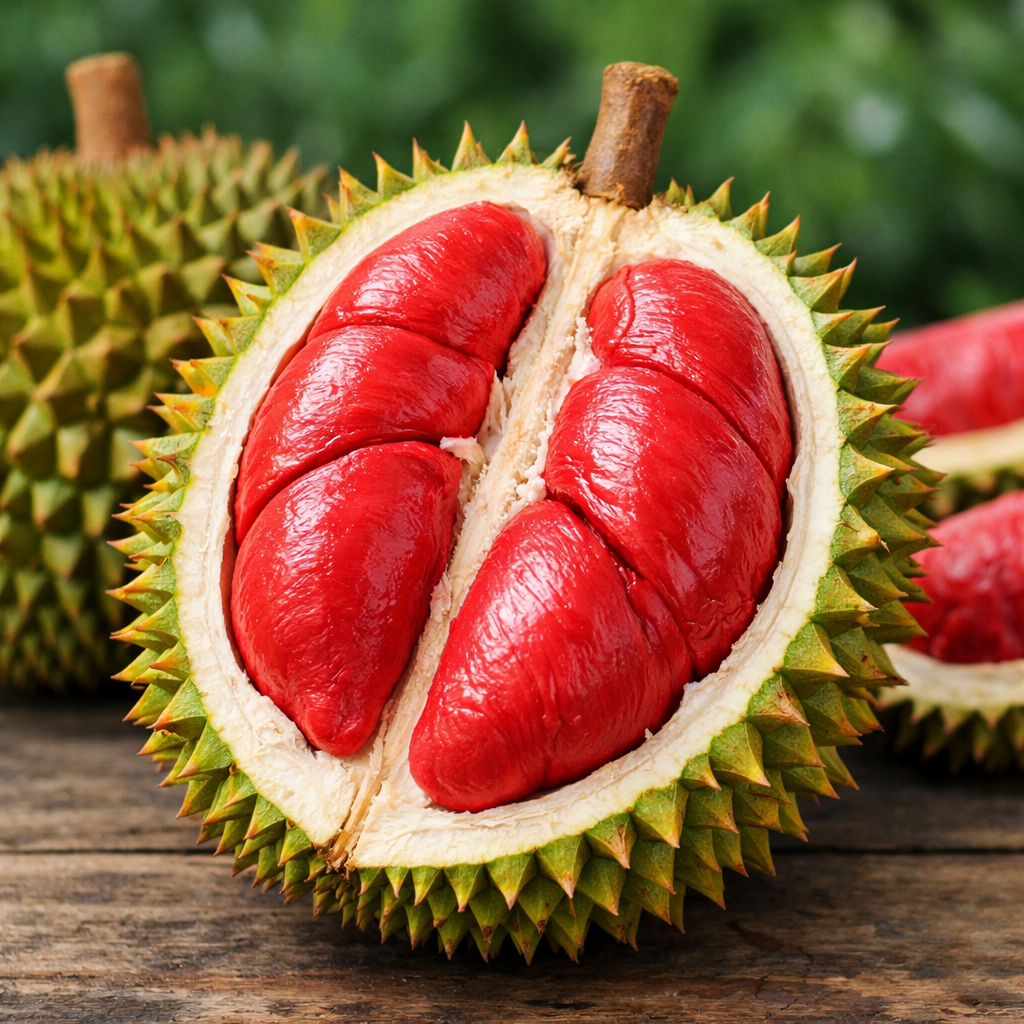
Nature rarely paints with such a defiant palette. Most people think of durian as a fruit with pale custard or buttery yellow flesh. These sections sit behind a fortress of green thorns. However, a botanical anomaly defies every expectation on the eastern tip of Java. Beneath the shadow of the brooding Ijen volcano, the Banyuwangi Red Durian grows. This is not merely a fruit. It is a visceral experience that challenges the senses. It redefines the identity of the “King of Fruits.”
[Image: A close-up of a split Banyuwangi Red Durian showing its vibrant crimson flesh]
This exotic treasure recently achieved a major milestone. It moved from a local curiosity to a famous heritage product. It earned the official status of Indikasi Geografis (Geographical Indication). This recognition proves that you cannot grow this fruit just anywhere. It belongs to the unique soil and mist of East Java. You can read more about our [guide to Indonesian exotic fruits] to see how it compares to other varieties.
Banyuwangi Red Durian: A Natural Masterpiece of Volcanic Terroir
The most jarring feature of the Banyuwangi Red Durian is its flesh. Breaking open the husk reveals a startling sight. You will see shades of deep crimson and brick red. Occasionally, a “rainbow” effect occurs where the red bleeds into soft yellows. To some, it looks like genetic engineering or a culinary prank. However, this vibrant hue is entirely natural. The unique environment on the slopes of Mount Ijen forged these genetics.
According to a botanical study on Indonesian fruit genetics, the color is more than a visual gimmick. It indicates a different chemical soul. Most common durians found in supermarkets offer a standard profile. In contrast, these red varieties are rich in Vitamin C and antioxidants. There is a primal satisfaction in eating something so intensely colored. This visual cue tells the palate to prepare for an extraordinary flavor profile.
The Shield of Geographical Indication for the Banyuwangi Red Durian
The recent awarding of the Indikasi Geografis (IG) status is a watershed moment. In the world of fine dining, provenance is everything. Champagne must come from France. Similarly, the Banyuwangi Red Durian now enjoys legal protection. Legal rules prevent others from hijacking the name for inferior varieties grown elsewhere.
This protection is vital because the “Banyuwangi” label signifies a specific quality standard. The volcanic soil acts as a natural laboratory. It infuses the fruit with a complexity that growers cannot replicate in generic orchards. For the consumer, this status guarantees authenticity. For local farmers, it acts as a shield against “food piracy.” It ensures the economic benefits remain within the community.
[Image: Local farmers harvesting Banyuwangi Red Durian at the foot of Mount Ijen]
A Symphony of Sixty-Five Varieties of Banyuwangi Red Durian
Recent research reveals that the Banyuwangi Red Durian is not a single type of fruit. Scientists and local harvesters have identified approximately 65 distinct varieties. This diversity is a dream for the gastronomic explorer. To speak of “red durian” as a single flavor is like calling all “wine” the same.
Within this spectrum, one variety might offer a creamy, sugary sweetness. Another might present a “premium” bitterness. Many aficionados crave this dark-chocolate-like undertone. It balances the rich fats of the fruit perfectly. The textures also vary from a cloud-like mousse to a dense bite. This internal diversity allows Banyuwangi to offer a curated tasting experience. Visitors can hunt for their specific preference among dozens of genetic iterations.
From Rarity to Global Gastronomy
Finding a Banyuwangi Red Durian was once like finding a needle in a haystack. Locals only spoke of the legendary fruit in whispers. Today, the landscape has changed. Successful cultivation efforts have led to thousands of new trees. Many of these are now reaching their peak productive years.
The fruit remains a premium item. It often commands higher prices than common yellow varieties due to seasonal demand. Because of this popularity, it has become a cornerstone of “agro-tourism.” Travelers now plan pilgrimages around the harvest season. They seek the thrill of eating the fruit at the source. You might also be interested in our [internal link on East Java travel tips] for the best harvest times.
The Palate’s Final Verdict
What is the ultimate allure of the Banyuwangi Red Durian? It is the intersection of history, biology, and sensory shock. It reminds us that nature still holds secrets. The flavor profile stays with you long after the fruit is gone. It offers a complex dance of sweet and savory notes.
The fruit has a high calorie count, so moderation is key. However, the experience of tasting a ruby-colored fruit is worth every bite. It tastes like a volcanic sunset. As the region continues to protect this treasure, the world of fine food gains a vibrant new chapter. The King of Fruits has a new crown, and it is a brilliant, unmistakable red.
[Video: A sensory tour of a Banyuwangi Red Durian orchard during harvest]
For more Food article, visit our
Food