
History wasn’t just written at Camp Nou—it was felt in every roar, every tackle, and every moment of tension that defined a title-deciding El Clasico.
Under the floodlights in Catalonia, FC Barcelona delivered a statement performance, defeating Real Madrid 2-0 to officially secure the 2025/2026 LaLiga title. It was more than just three points. It was confirmation of a new order in Spanish football.
For the second consecutive season, Barcelona stand at the summit—and this time, it feels like the beginning of something bigger.
The Flick Era: From Experiment to Dominance
When Hansi Flick took charge, skepticism followed.
Could his high-intensity pressing system truly work in LaLiga?
Could Barcelona evolve without abandoning their identity?
Fast forward to May 2026, and those doubts have been erased.
Barcelona didn’t just win the league—they controlled it. With 91 points and matches still to spare, Flick’s side has blended positional play with relentless vertical transitions, creating a hybrid system that feels both modern and unmistakably “Barça.”
Against Madrid, that identity was on full display:
- 60% possession
- aggressive counter-pressing
- disciplined defensive structure
This wasn’t just tactical superiority—it was total control.
El Clasico as the Ultimate Statement
If titles define seasons, El Clasico defines eras.
Barcelona knew what was at stake. And they played like it.
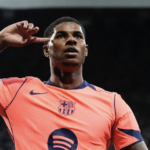
The breakthrough came from Marcus Rashford, whose transformation in Spain has been nothing short of remarkable. Signed amid questions about consistency, Rashford has become one of the most decisive forwards in Europe this season.
His goal wasn’t just clinical—it was symbolic. A representation of Barcelona’s evolution: fast, direct, and ruthless.
Real Madrid, for all their pedigree, struggled to respond.
The second goal, finished by Ferran Torres, effectively ended the contest. A defensive lapse, a composed finish—and just like that, the title was sealed.
At 2-0, the Camp Nou didn’t just celebrate. It erupted.
Real Madrid: A Giant Under Pressure
For Real Madrid, this defeat raises uncomfortable questions.
Once the dominant force in Spanish football, Madrid now finds itself reacting rather than dictating. The gap in titles remains—36 to Barcelona’s 29—but momentum has clearly shifted.
This wasn’t just a defeat.
It felt like a warning.
Barcelona are building. Madrid must respond.
Back-to-Back Titles: A Statement of Stability
Winning LaLiga once can be momentum.
Winning it twice in a row is identity.
This marks Barcelona’s first successful title defense since 2018–2019, and it highlights something the club has lacked in recent years: continuity.
Under Flick:
- the system is clear
- the roles are defined
- the squad depth is functional
There is no chaos. No uncertainty. Just progression.
More Than Football: The Business of Winning
In today’s game, success on the pitch fuels everything off it.
Barcelona’s back-to-back titles bring:
- increased global engagement
- commercial growth
- stronger leverage in transfers
Projects like Espai Barça gain momentum, sponsors return with confidence, and the club’s global identity strengthens once again.
Winning isn’t just sporting success—it’s economic power.
What Comes Next?
With domestic dominance secured, attention now shifts to Europe.
The Champions League remains the ultimate goal—the final piece needed to complete Barcelona’s resurgence.
But this time, the narrative feels different.
This isn’t a team chasing past glory.
This is a team building a new legacy.
Final Thought
Barcelona didn’t just win LaLiga.
They defined it.
And as the celebrations echo through Camp Nou and beyond, one question lingers over European football:
Is this the beginning of a new Barcelona dynasty?