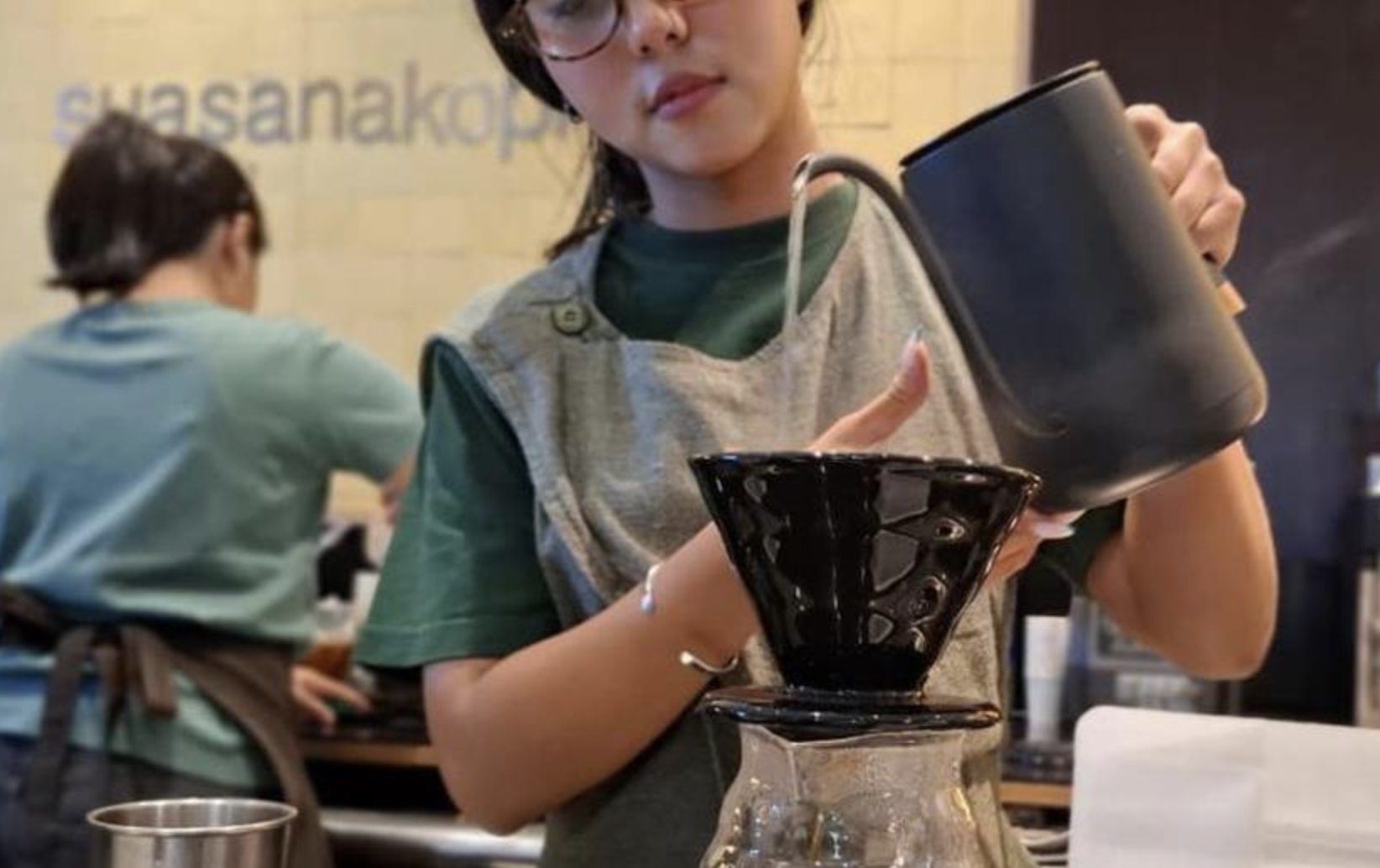
In the hallowed halls of “The Gilded Fork,” we often find ourselves tracing the lineage of flavor back to its ancestral roots. Coffee, once a bitter elixir brewed in heavy iron pots over open flames, has undergone a renaissance of clarity. This week, we stepped away from the silver service of grand hotels to visit the contemporary masters of the craft. At the heart of Jakarta’s bustling Sarinah district, we met with Jasmine, a professional barista from Suasanakopi, who is demystifying the alchemical process of the pour-over. Her approach is not merely about caffeine delivery; it is a nod to the historical shift toward “Third Wave” coffee, where the bean’s origin—in this case, the rugged highlands of Aceh Gayo—is treated with the same reverence as a Grand Cru vineyard.
The Ritual of the Ritual: Why Suasanakopi Values Precision
To understand the manual brew is to understand the evolution of Japanese glasswork and German ingenuity. While the concept of drip coffee dates back to Melitta Bentz’s 1908 invention using her son’s blotter paper, the V60 method championed by Suasanakopi represents the pinnacle of that evolution. The “60” refers to the 60-degree angle of the cone, a geometry designed to allow water to flow toward the center, extending the contact time with the grounds.
Jasmine emphasizes that the transition from a casual drinker to a “home brewer” requires a shift in mindset. “It isn’t just about pouring water,” she explains. “It’s about controlling the variables that history has taught us matter most: temperature, time, and turbulence.” For those looking to replicate the Michelin-star quality of a professional cafe at home, the journey begins with the right equipment: a V60 dripper, a server, a paper filter, a goose-neck kettle, and a precise digital scale.
Step 1: The Purity of the Paper
The first tip Jasmine shares is one often overlooked by the uninitiated: the “flushing” or rinsing of the paper filter. In the early 20th century, paper filters often left a distinct woody or “cardboard” aftertaste in the cup. By pouring hot water through the empty filter into the server, you not only remove any residual paper dust but also pre-heat the vessel.
“If the vessel is cold, the thermal shock will kill the delicate floral notes of the Aceh Gayo,” Jasmine notes. This attention to detail is what defines the specialty coffee culture today—a relentless pursuit of a “clean” cup that allows the terroir of the bean to shine through without interference.
Step 2: The Geometry of the Grind
When discussing the beans, Jasmine insists on a 1:15 ratio—15 grams of coffee to 225 milliliters of water. However, the true secret lies in the grind size. For a V60, a “medium-to-fine” texture is paramount. If the grind is too coarse, the water rushes through too quickly (under-extraction), resulting in a sour, thin tea. If too fine, the water stalls (over-extraction), producing a bitter, ashy brew.
Historically, the Aceh Gayo region has been known for its earthy, full-bodied profiles. However, through the Suasanakopi lens, using a medium-to-fine grind and water temperatures between 85-92 degrees Celsius, one can extract a surprising acidity and sweetness that rivals the best harvests from Ethiopia or Colombia.
Step 3: The Science of the Bloom
Watching Jasmine brew is like watching a chemist at work. She begins with the “bloom”—pouring 30ml of water over the grounds and waiting. This 30-second pause allows carbon dioxide to escape. In the world of high-end gastronomy, we understand that gas is the enemy of flavor; if the gas remains, it repels the water, preventing the extraction of the coffee’s essential oils.
Following the bloom, Jasmine executes three controlled intervals of 65ml each. This rhythmic pouring ensures that the water remains at a consistent temperature and that the grounds are agitated just enough to release their hidden complexities.
Step 4: The Final Swirl for a Clean Finish
The final tip is perhaps the most sensory. Once the extraction is complete, Jasmine gently swirls the server. This isn’t just for show. “Swirling homogenizes the brew,” she says. “The coffee at the bottom of the server is denser and more concentrated than the coffee at the top. Swirling mixes them, while also aerating the liquid to open up the aroma.”
This aeration is similar to decanting a fine Bordeaux. As the steam rises, the olfactory senses are primed, allowing the palate to detect notes of dark chocolate, spice, and the slight citrus finish characteristic of the Gayo bean. It results in a “clean” finish—a term we use at “The Gilded Fork” to describe a profile that leaves the palate refreshed rather than coated in sediment.
Bringing the Cafe Experience Home
The beauty of the Suasanakopi method lies in its accessibility. While the history of coffee is a long and winding road of industrialization and mass production, the manual brew is a return to the artisanal. It reminds us that luxury is not always found in expensive machinery, but in the patience and precision of the human hand.
For those interested in exploring more about the nuances of bean origins, you might enjoy our previous look at the art of the perfect espresso. As Jasmine proved at Sarinah, the perfect cup is within reach of anyone willing to master the flow.
To learn more about brewing techniques and the latest in coffee trends, experts at Bon Appétit suggest that the quality of your water is just as important as your beans—a sentiment we wholeheartedly echo here at “The Gilded Fork.”
Discover the latest coffee trends, recipes, and news by exploring our coverage here.